

- Design and dimensions: three-row electric SUV with serious presence
- Powertrain: dual motors and a massive 110.3 kWh battery
- Quick technical table
- Cabin: semi‑premium ambience with familiar Hyundai DNA
- Six seats or seven? Usability across three rows
- Driving character: strong performance, comfort‑first tuning
- Range and charging: big battery, strong real‑world numbers
- Driver assistance: polished long‑distance companion
- Pricing: does it deserve to be Hyundai’s priciest model?
- The biggest challenge: competition from Hyundai’s own lineup
- A strong family EV… if you’re truly committed to electric
The 2026 Hyundai Ioniq 9 Calligraphy represents a bold move from the Korean brand into the world of large, luxury three-row electric SUVs, but the irony is that its toughest competition may come from within Hyundai’s own stable, via models like the Kia EV9, Santa Fe, and Palisade. The SUV is designed to deliver a near-premium experience in technology, comfort, and range, with pricing that places it somewhere between mainstream Hyundai products and the luxury arm Genesis, making it an attractive option for families that want a big electric SUV without stepping into a full luxury marque.
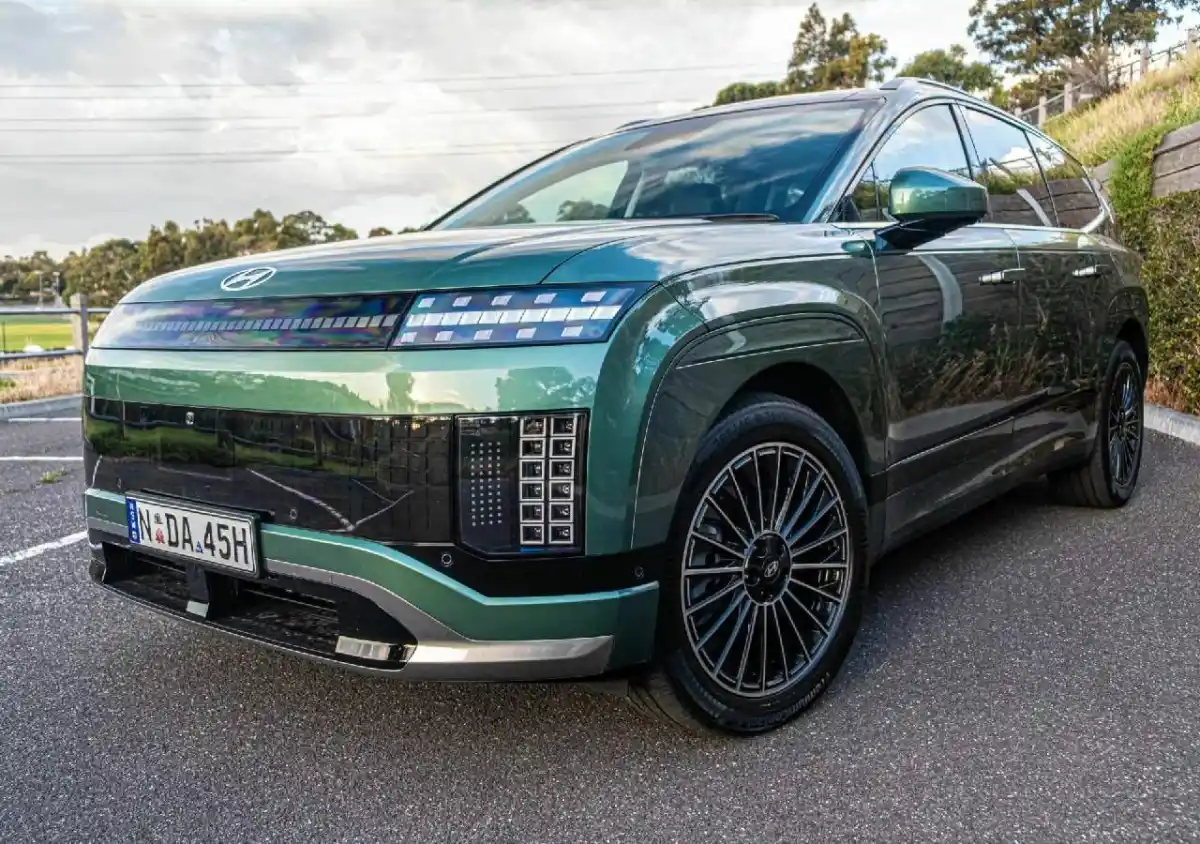
Design and dimensions: three-row electric SUV with serious presence
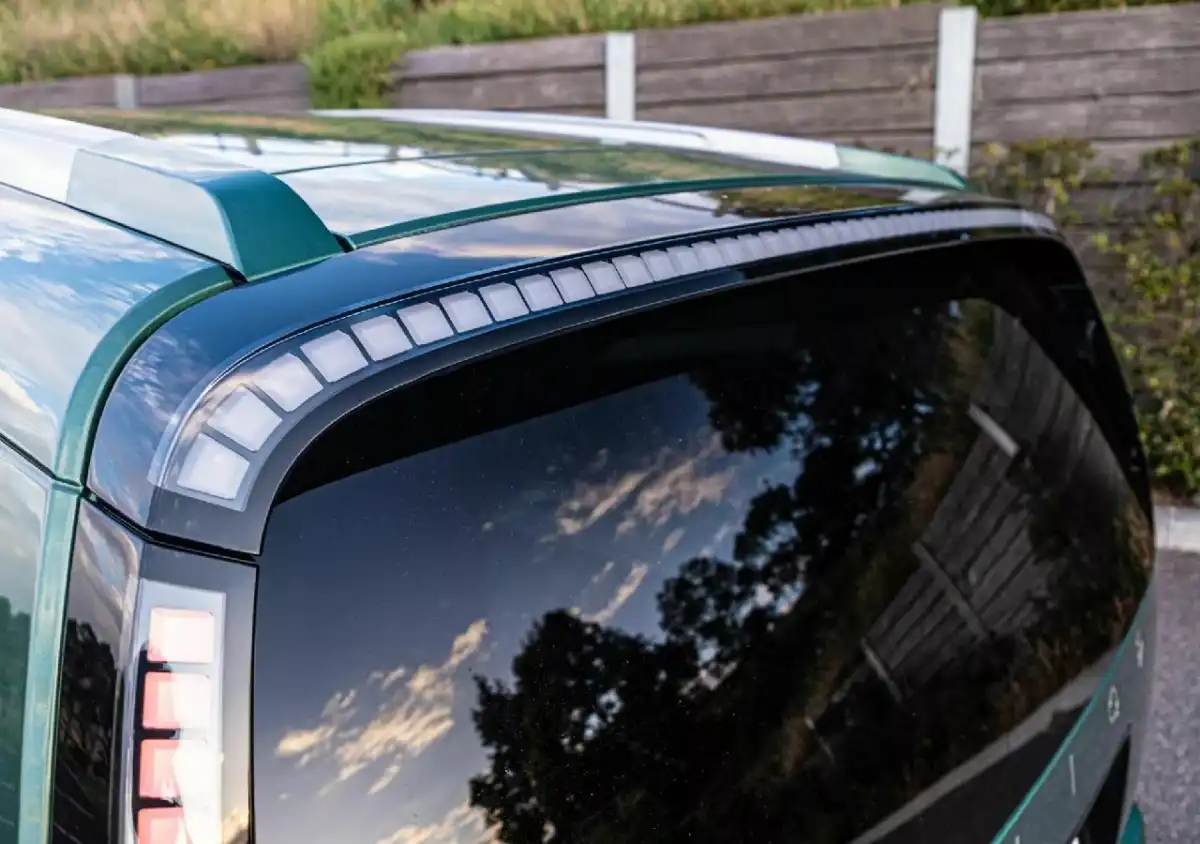
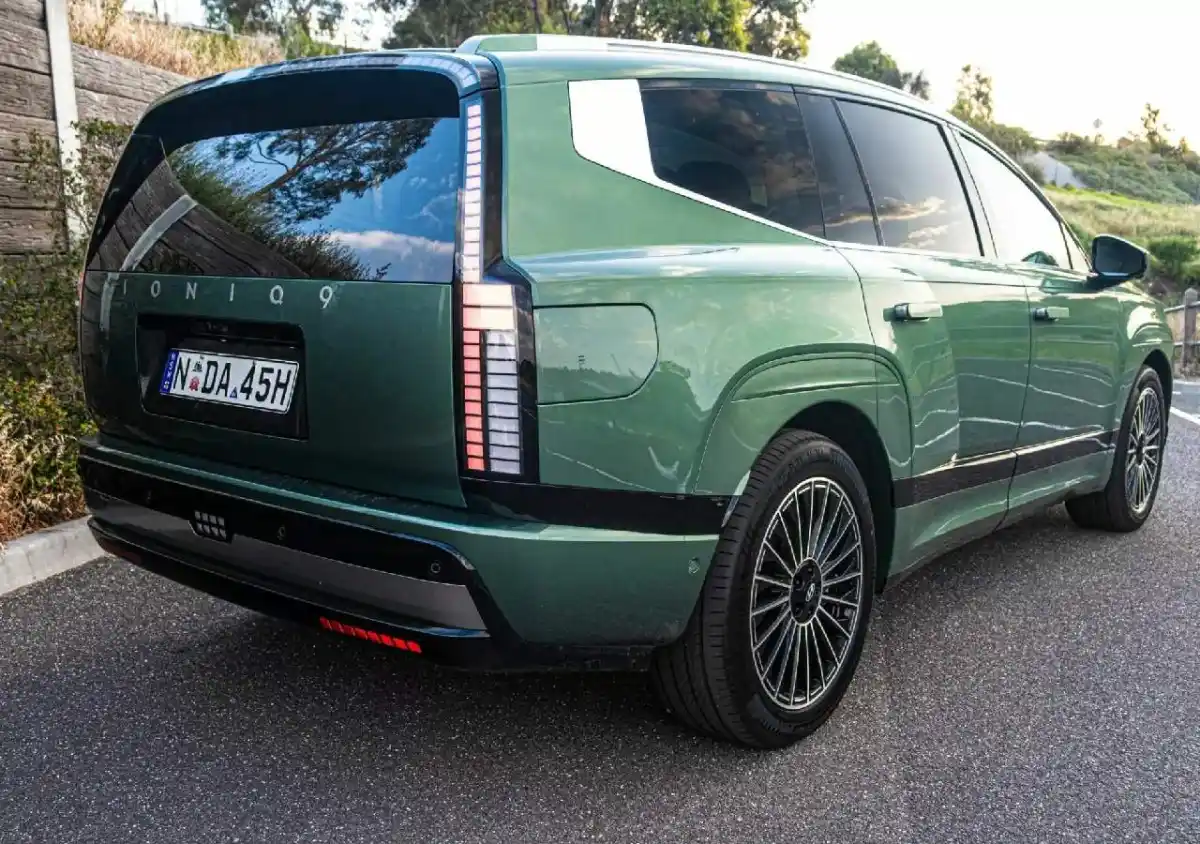
The Ioniq 9 Calligraphy arrives with a bold, concept-like design, full of sharp, squared-off lines and a futuristic stance, visually related to the Kia EV9 but clearly carrying Hyundai’s own identity. It measures about 5,060 mm in length, roughly 1,980 mm in width, and around 1,790 mm in height, with a long 3,130 mm wheelbase that underpins generous space across all three rows. These proportions make it slightly longer than the EV9 and even longer than some traditional full-size luxury SUVs, reinforcing a sense of size and road presence.
Key dimensional numbers:
Length: approx. 5,060 mm
Width: approx. 1,980 mm
Wheelbase: approx. 3,130 mm
Curb weight: around 2,721 kg (nearly 6,000 lbs)
This footprint positions it right in the heart of the large family SUV segment, with enough space and stature to take on rivals from both inside and outside the Hyundai–Kia group.
Powertrain: dual motors and a massive 110.3 kWh battery
Underneath, the Ioniq 9 uses a modern dedicated EV platform with a huge 110.3 kWh battery pack, even larger than the 99.8 kWh unit used in top versions of the Kia EV9. This battery feeds two electric motors, one on each axle, each rated at about 157 kW, for a combined output of around 314 kW (421 hp) and 700 Nm of torque.
Core performance figures:
System output: approx. 421 hp (314 kW)
Torque: 700 Nm
0–100 km/h: roughly 5.2 seconds, impressive for an SUV weighing close to 2.7 tonnes
This gives the Ioniq 9 the character of a powerful crossover in straight‑line driving, easily out‑accelerating many hot hatches, with the instant response and seamless thrust expected from a dual‑motor EV.
Quick technical table
Item | Approximate value |
|---|---|
Battery | 110.3 kWh |
Motors | Dual (front + rear) |
Total power | 421 hp / 314 kW |
Torque | 700 Nm |
0–100 km/h | 5.2 seconds |
Curb weight | ~2,721 kg |
Cabin: semi‑premium ambience with familiar Hyundai DNA
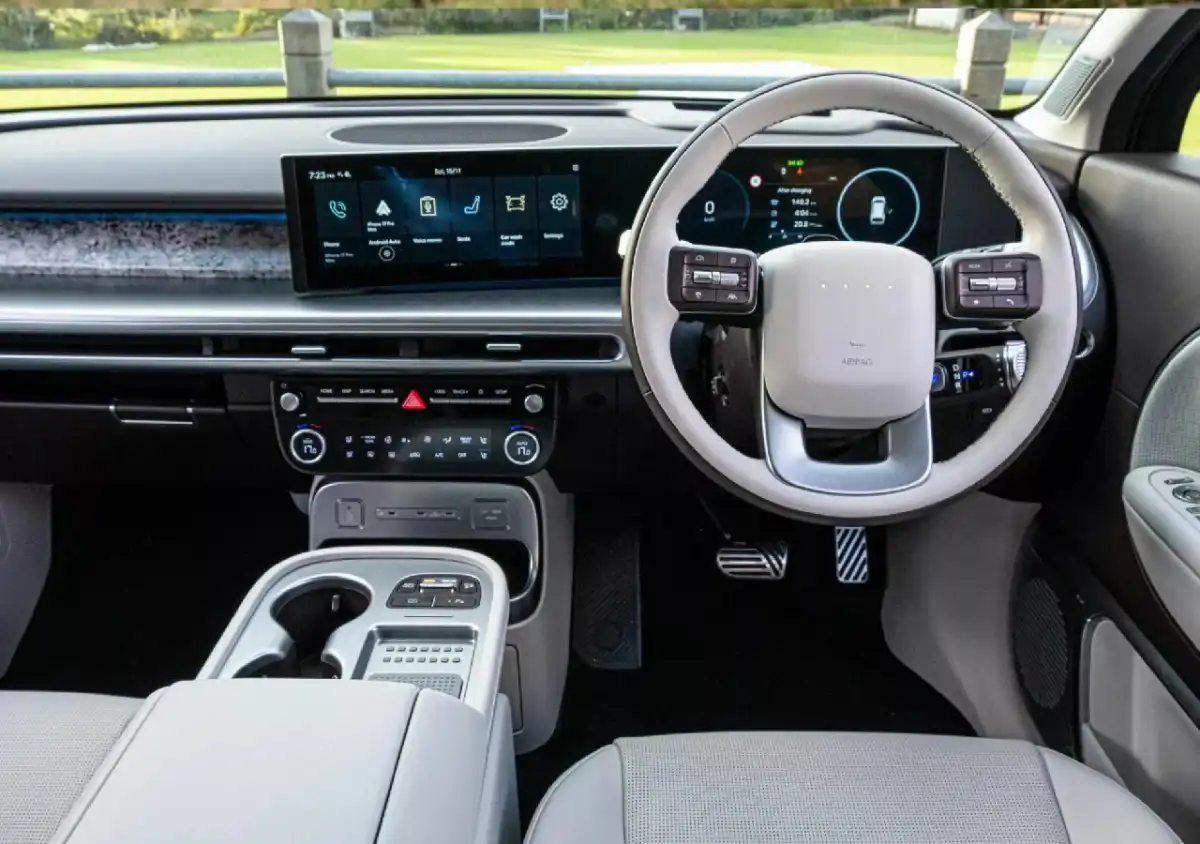
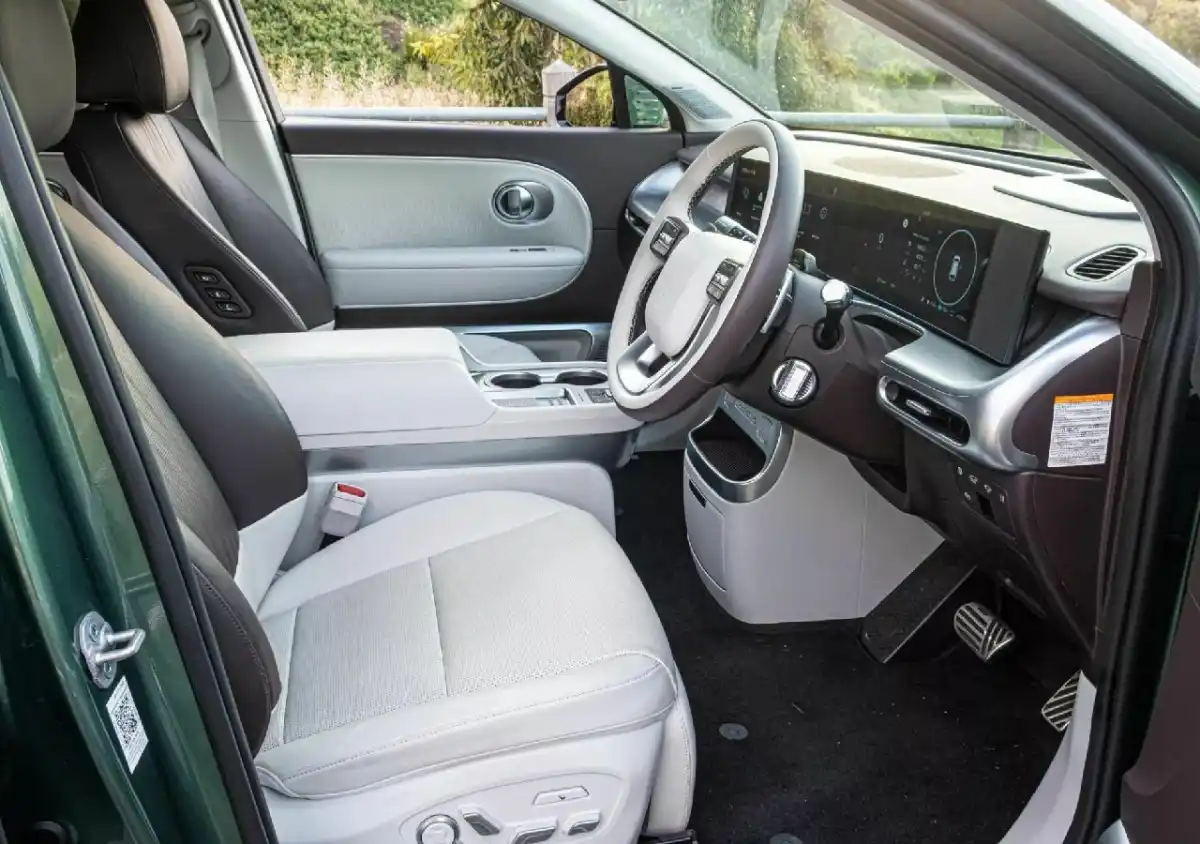
Inside, the Ioniq 9 Calligraphy pushes beyond typical Hyundai cabins into what can be fairly called a “semi‑luxury” interior, even though it still shares many components with the Santa Fe and Palisade.
Design and screens:
A pair of 12.3‑inch displays housed in a single curved panel in front of the driver, with one for the instrument cluster and one for infotainment, both supporting wireless Apple CarPlay and Android Auto.
A separate dedicated climate control display below the main dash, using a mix of touch controls and physical temperature dials, avoiding the less ergonomic triple‑screen approach seen in some other models.
Materials and colours:
Optional Nappa leather two‑tone interiors (for example, Dark Wine and Dove Grey) in addition to a more traditional all‑black Obsidian trim.
Extensive use of soft‑touch materials, with noticeably less hard plastic than the EV9, giving the Ioniq 9 a slightly more refined feel, even if a lot of switchgear and design language remains shared with other Hyundais.
Key comfort and convenience features:
Heated, ventilated and massaging front seats.
Heated steering wheel.
Wireless smartphone charging pad.
Large panoramic sunroof.
Tri‑zone climate control.
Configurable ambient lighting.
Head‑up display (HUD).
High‑power 100 W USB‑C ports in the dash and on the back of the front seats to keep multiple devices fast‑charging.
Collectively, these features make the Ioniq 9 feel very well suited to long‑distance touring and premium daily family use.
Six seats or seven? Usability across three rows
Hyundai offers the Ioniq 9 Calligraphy with a choice of six or seven seats:
Six‑seat configuration:
The second row is fitted with a pair of captain’s chairs similar in comfort and design to the front seats, making this the best choice for those who prioritise rear passenger luxury.
Seven‑seat configuration:
A conventional three‑person bench in the second row, with space sufficient for three adults in comfort.
Even the third row is surprisingly usable. A person around 189 cm (6’2”) can sit there with only light contact between hair and headliner, as long as the second‑row seats are slid slightly forward to free up knee space. Nevertheless, cabin size and impression are not overwhelmingly larger than a Santa Fe or Palisade; it feels like a clear step up, but not a dramatic leap in sheer volume.
Driving character: strong performance, comfort‑first tuning
On a straight road, the Ioniq 9 Calligraphy behaves very much like a performance EV, even if it isn’t marketed under a performance badge in some markets. Flatten the accelerator and the SUV surges forward, squatting slightly at the rear and launching with conviction that belies its mass.
In corners, it doesn’t quite match the unexpected agility of the Kia EV9 GT‑Line, but it can still be driven quickly thanks to good tyre grip and carefully tuned stability systems. Its basic personality, however, leans more toward relaxed, refined cruising than enthusiastic back‑road driving.
Ride and refinement:
Suspension tuning is noticeably more comfort‑oriented than in the EV9 GT‑Line, with well‑judged bump absorption and a generally supple feel.
Despite its considerable weight, Hyundai has achieved a ride quality that is impressively compliant for a three‑row EV, even if the lighter, more compact Santa Fe still edges it for ultimate plushness in some situations.
Range and charging: big battery, strong real‑world numbers
Thanks to its large battery and respectable efficiency, the Ioniq 9 offers very usable real‑world range for families:
Claimed range: up to around 600 km per charge, depending on conditions and specification.
Quoted consumption: roughly 20.6 kWh/100 km.
Real‑world test example: around 22 kWh/100 km, covering about 210 km while still retaining close to 300 km of indicated remaining range.
Charging capability:
DC fast charging up to 233 kW, allowing a 10–80% top‑up in about 24 minutes when using a suitable 350 kW charger.
AC charging at up to around 10.5 kW, ideal for overnight home charging or slower public chargers.
These figures make the Ioniq 9 a strong candidate for daily use and long‑trip duties, assuming decent charging infrastructure.
Driver assistance: polished long‑distance companion
The Ioniq 9 Calligraphy comes with Hyundai’s latest driver assistance suite, including Highway Driving Assist 2 (HDA2), which combines:
Adaptive radar cruise control.
Lane keeping and lane‑centering assistance, including automated lane‑change capability in some conditions.
The ability to subtly move the vehicle toward the edge of the lane when passing large trucks, adding a sense of reassurance on multi‑lane highways.
In practice, this system delivers smooth and confidence‑inspiring semi‑autonomous behaviour on motorways, reducing fatigue while still keeping the driver engaged.
Pricing: does it deserve to be Hyundai’s priciest model?
In markets like Australia, the Ioniq 9 Calligraphy starts at around AU$128,413 including on‑road costs, making it the most expensive Hyundai sold there to date. Even so, it undercuts the closest Kia EV9 equivalent (GT‑Line) by roughly AU$10,000 while offering essentially the same powertrain.
In the United States, pricing starts from about US$58,955, with top Performance Calligraphy‑style trims climbing to around US$76,490, positioning the Ioniq 9 squarely against the EV9 and a variety of other large electric SUVs from rival brands.
In GCC markets, based on how similar EVs and large Hyundais are currently priced, the Ioniq 9 is expected to start in roughly the SAR 260,000–280,000 band (around AED 255,000–270,000), with higher figures for fully loaded trims depending on local specs, taxes, and bundled warranty or service packages.
The biggest challenge: competition from Hyundai’s own lineup
Ironically, the strongest headwinds for the Ioniq 9 may not come from European or American rivals, but from Hyundai’s own models:
A seven‑seat Santa Fe Hybrid Calligraphy can be bought for around AU$50,000 less in some markets, while delivering a very similar interior ambience and technology package.
The all‑new Palisade, available with seven or eight seats, comes in about AU$30,000 cheaper than an Ioniq 9, yet still feels every bit as polished and comfortable to many buyers.
For shoppers who are not firmly committed to going fully electric, this price gap raises an obvious question: does the EV powertrain alone justify such a premium over well‑equipped hybrid or petrol SUVs that share much of the look and feel?
A strong family EV… if you’re truly committed to electric
Judged purely as a standalone electric SUV, the 2026 Hyundai Ioniq 9 Calligraphy makes a very convincing case: strong performance, solid real‑world range, excellent fast charging, a refined and practical cabin, and a deep roster of comfort and safety tech. It sits comfortably among the better large EV SUVs currently on sale.
However, when you place it alongside Hyundai’s own hybrids and combustion SUVs, the bigger question becomes whether you are personally ready to pay the electric premium. If the answer is yes, and you specifically want a large, three‑row electric SUV for family use, the Ioniq 9 is one of the easiest models in its class to recommend.