

- Financials: Scale, Cash and Technology Still Form the Foundation
- Industry: The Question Is No Longer Who Sells More, but Who Can Go Further Abroad
- The Middle East: From Market Entry to Strategic Dialogue
- Cartea’s Observation: What Is Actually Changing in the Middle East Market
- Competition: A Market Growing More Complex
- Conclusion: The Middle East Is Becoming a Front Line for Capability Verification
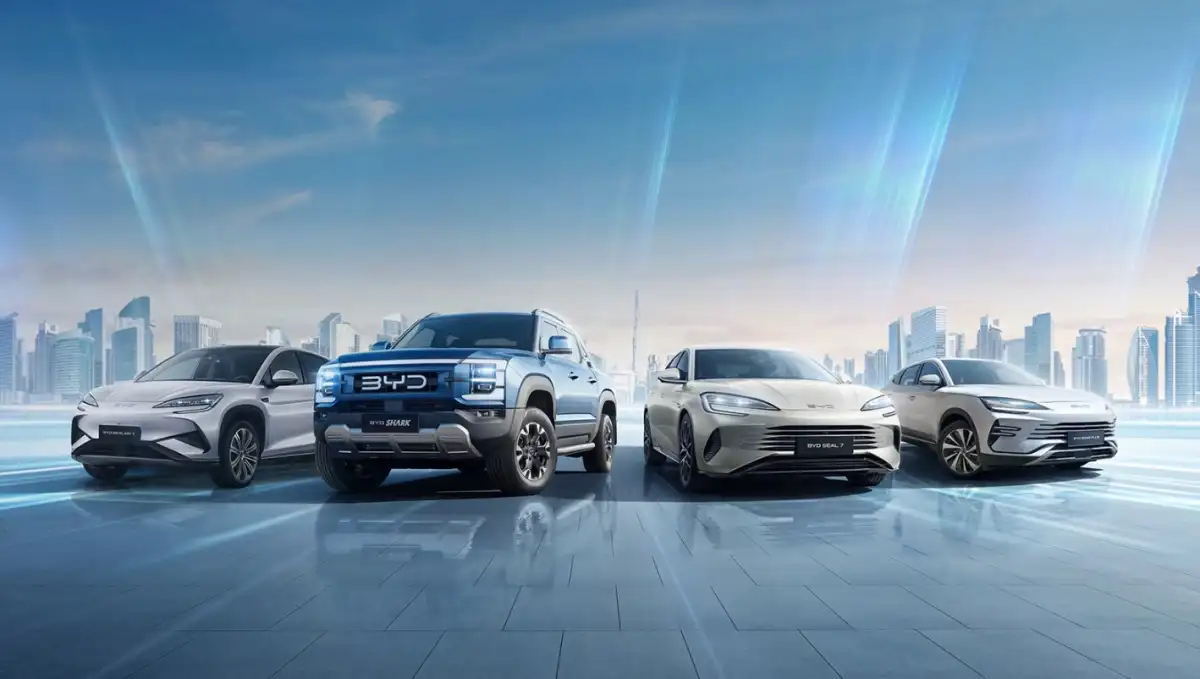
Against the backdrop of China’s new energy vehicle market entering a deeper phase of competition, BYDEgypt BYDUAE BYDKSA BYDBahrain BYDKuwait BYDOman BYDQatar BYD’s 2025 annual results reflect more than another year of continued growth. When read alongside its recent moves in the Middle East, the report looks increasingly like a signal of transition—from a growth model driven primarily by scale to one shaped more by global expansion.
Financials: Scale, Cash and Technology Still Form the Foundation
From a financial perspective, BYD continues to maintain a strong base.
In 2025, the company reported revenue of RMB 804 billion and net profit of RMB 32.6 billion, remaining profitable despite intensifying price competition. Annual NEV sales exceeded 4.6 million units, keeping BYD in the global lead. At the same time, RMB 63.4 billion in R&D spending and cash reserves of more than RMB 160 billion provided the company with room to continue investing in technology and international expansion.
What is more notable, however, is the shift in structure. The contribution of premium brands has increased, and BYD’s product mix is gradually moving toward higher-value segments. On the technology side, continued investment across batteries, hybrid systems, and intelligent driving platforms has allowed the company to retain strong technological output.
Yet these strengths also point to an underlying reality: as pricing pressure in the domestic market persists, BYD increasingly needs new markets to absorb the balance between growth and profitability.
Industry: The Question Is No Longer Who Sells More, but Who Can Go Further Abroad
Over the past several years, the core logic of China’s NEV industry has been built on scale expansion and cost efficiency. By 2025, that logic is beginning to change.
On one hand, the room for incremental growth is narrowing as domestic penetration rates rise. On the other hand, price competition is squeezing margins, forcing companies to invest more heavily in technology, branding, and distribution. Under these conditions, going overseas is no longer optional; for leading companies, it is becoming a necessary path.
In this transition, the real dividing line is no longer volume alone. It is whether an automaker can replicate its capabilities across markets—whether it can adapt to different climate conditions, understand local consumer behavior, and rebuild channels and after-sales systems in entirely new environments.
The Middle East: From Market Entry to Strategic Dialogue
If BYD’s recent overseas moves are viewed together, the Middle East is clearly moving up the priority list.
In early 2026, during Abu Dhabi Sustainability Week, BYD Chairman Wang Chuanfu met with Sheikh Khaled bin Mohamed bin Zayed Al Nahyan in Abu Dhabi. Sheikh Khaled is the Crown Prince of Abu Dhabi and also serves as Chairman of the Abu Dhabi Executive Council, overseeing the emirate’s economic and industrial development.
Judging from the subjects discussed, the exchange went well beyond vehicle sales. The conversation extended to the development of the new energy vehicle industry, local manufacturing capabilities, and sustainable transport systems. Engagement at this level usually indicates that a company has entered a phase of industrial coordination with government stakeholders, rather than remaining in a purely commercial expansion stage.
That, in turn, suggests a shift in BYD’s role in the region—from a market participant to a potential industrial participant.
Cartea’s Observation: What Is Actually Changing in the Middle East Market
Compared with public announcements, what Cartea sees on the ground offers a clearer sense of how the market is actually evolving.
Over the past six months, BYD’s visibility has increased noticeably across core automotive districts in Dubai and Abu Dhabi. Among showroom visitors, the share of first-time consumers engaging with Chinese brands has risen significantly. In particular, buyers who previously focused only on Japanese and Korean brands are now beginning to include BYD in their comparison set.
That said, the conversion process remains relatively long. Most users do not make an immediate decision after their first showroom visit. Instead, they enter a prolonged observation period. The main concerns during this phase tend to center on vehicle stability under extreme climate conditions, long-term maintenance costs, and future residual value.
In terms of usage scenarios, plug-in hybrid models are being accepted more readily than pure EVs. For users who frequently drive long distances, hybrids offer a more controllable transitional solution. Pure EVs, by contrast, are often seen as worth considering, but not yet a fully comfortable choice for everyone.
On the channel side, BYD has rapidly established a basic sales and service network through its partnership with Al-Futtaim Group. However, compared with more established brands, both after-sales density and brand trust are still in the process of being built.
Competition: A Market Growing More Complex
The Middle East’s traditional competitive structure is also beginning to change.
For years, the market was defined by a relatively stable order led by Japanese and Korean brands, which gave the region a strong degree of inertia. But as more Chinese automakers enter the market in a concentrated way, that structure is beginning to loosen. Consumer choice is expanding quickly, and brand competition is shifting from simple substitution to a more complex multi-sided contest.
In this environment, price and configuration are no longer the only variables that matter. Brand trust, service capability, and long-term ownership cost are becoming increasingly important factors in the purchase decision.
Conclusion: The Middle East Is Becoming a Front Line for Capability Verification
For BYD, the central question at this stage is no longer whether it can maintain sales growth, but whether it can build a stable and replicable capability system across different markets.
The importance of the Middle East lies in the fact that it combines growth potential with structural complexity. That makes it a market closer to a real global sample than many others.
Here, BYD is being forced to revalidate the path it has already proven in China—but under conditions of greater uncertainty and stricter demands.
The financial report represents the past. What is happening in the Middle East will help determine the company’s next phase.