

In 2025, the structural shift in the global automotive industry has become increasingly visible.
While legacy automakers such as ToyotaBahrain ToyotaEgypt ToyotaKSA ToyotaKuwait ToyotaOman ToyotaQatar ToyotaUAE Toyota, VolkswagenUAE VolkswagenBahrain VolkswagenEgypt VolkswagenKSA VolkswagenKuwait VolkswagenOman VolkswagenQatar Volkswagen, and HyundaiUAE HyundaiBahrain HyundaiKuwait HyundaiOman HyundaiQatar HyundaiKSA HyundaiEgypt Hyundai continue to dominate the top ranks in terms of volume, Chinese carmakers are rapidly integrating into the global system. Leading Chinese groups collectively sold close to 17 million vehicles, with companies like BYDEgypt BYDUAE BYDKSA BYDBahrain BYDKuwait BYDOman BYDQatar BYD and GeelyUAE GeelyKSA GeelyKuwait GeelyQatar GeelyOman GeelyBahrain GeelyEgypt Geely entering the global top tier.
Yet the more important change lies not in scale, but in where that growth is coming from. Chinese automakers are no longer driven solely by domestic demand; instead, they are transitioning toward a dual-engine model combining domestic and overseas markets. Europe has become the primary engine for short-term expansion, while regions such as the Middle East and Southeast Asia are emerging as new sources of incremental growth.
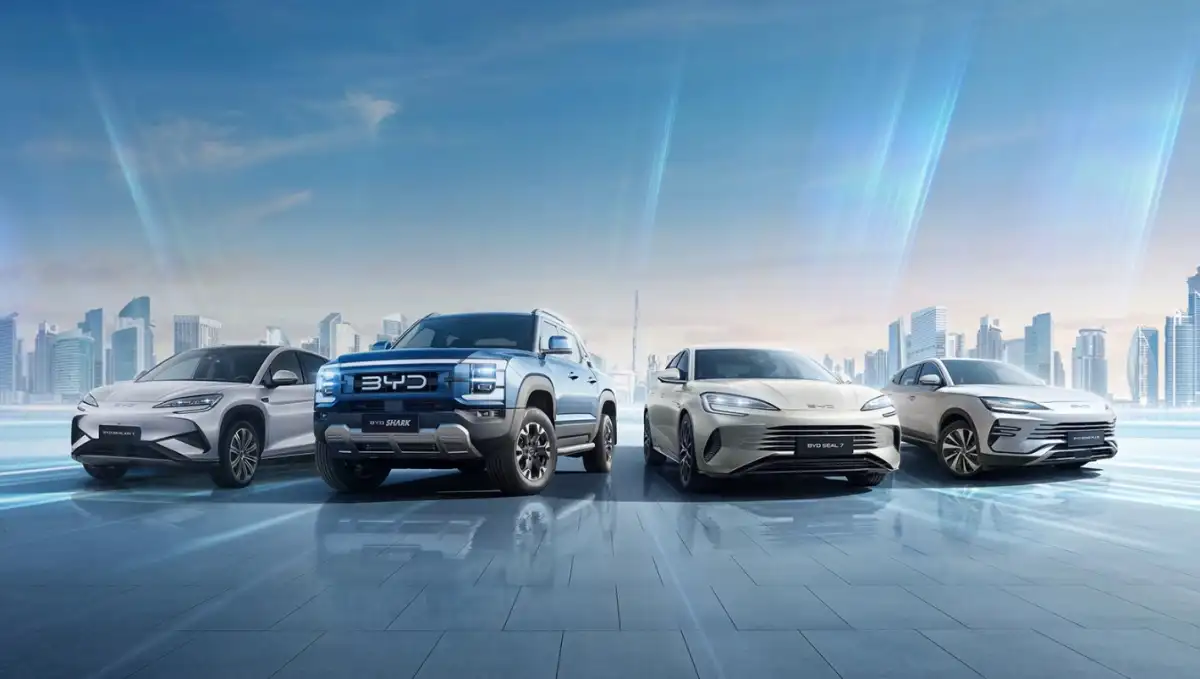
BYD: Overseas Becomes the Second Engine, Middle East Nearing Inflection Point
BYD surpassed 4 million units in global sales in 2025, maintaining its leadership in the global new energy vehicle segment. What stands out this year is a clear shift in growth composition: domestic sales showed mild pressure, while overseas markets more than doubled, exceeding 700,000 units with year-on-year growth above 120%.
Europe remains BYD’s most important overseas market, with explosive growth across the UK, Germany, and Italy. However, the company’s global strategy is gradually evolving from a Europe-centric model toward a more diversified regional structure.
In the Middle East, BYD is still in the phase of brand building and channel expansion. However, early indicators are emerging. In markets like the UAE, showroom traffic and test-drive conversion rates have increased significantly, and EVs are beginning to enter mainstream consumer consideration.
Overall, BYD is transitioning from an export-driven model to a regionally operated one, with the Middle East likely to become its next growth frontier after Europe.

SAIC Motor: UAE MGKSA MGOman MGQatar MGBahrain MGEgypt MGKuwait MG Anchors Global Presence, Middle East as a Mature Operational Market
SAIC Motor recorded close to 2 million units in global sales in 2025, maintaining stable, single-digit growth despite a complex global trade environment.
Its overseas strength continues to rely heavily on the MG brand, which has established a strong foothold in Europe, particularly in the UK, Spain, and Italy, accounting for the majority of SAIC’s international volume.
Compared to Europe, SAIC’s operations in the Middle East are more mature. MG has already built a relatively complete distribution and after-sales network across key markets such as the UAE and Saudi Arabia, enabling consistent and stable sales performance.
Unlike newer entrants, SAIC’s advantage in the region lies not in rapid expansion, but in sustained operational capability. Structurally, it is one of the few Chinese automakers that has already laid the foundation for a global network, with the Middle East serving as a key proof point.
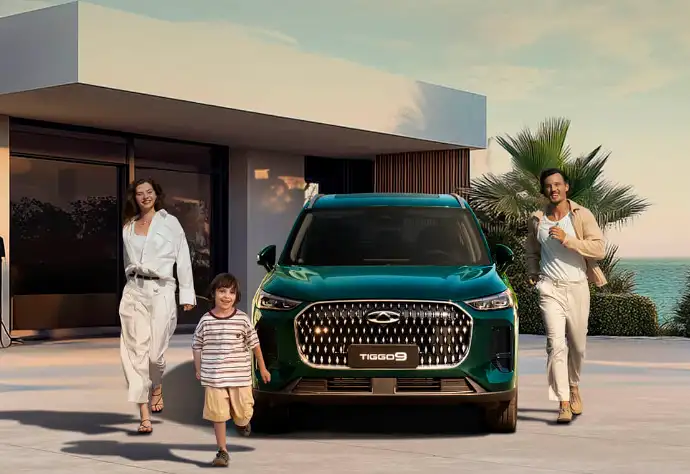
CheryKSA CheryKuwait CheryQatar CheryBahrain CheryUAE CheryOman CheryEgypt Chery: Rising Overseas Contribution, Middle East and Latin America Form Dual Pillars
Chery Group surpassed 2.1 million units in sales in 2025, with overseas markets contributing nearly 30%, making it one of the most internationally oriented Chinese automakers.
Its growth is largely driven by sub-brands such as OmodaBahrain OmodaEgypt OmodaKSA OmodaKuwait OmodaOman OmodaQatar OmodaUAE Omoda and JaecooBahrain JaecooEgypt JaecooKSA JaecooKuwait JaecooOman JaecooQatar JaecooUAE Jaecoo. Through brand repositioning, Chery has rapidly entered markets across Europe and the Middle East, with overseas volumes expanding from tens of thousands to well over 100,000 units.
Regionally, Chery has developed a dual-pillar structure: Latin America provides scale, while Europe and the Middle East deliver growth momentum. In the Middle East, its multi-brand strategy allows it to cover a wide range of price segments and gradually establish brand presence.
Compared to its peers, Chery’s diversified geographic footprint reduces reliance on any single market, enhancing resilience amid global volatility.

XPeng: Rapid Growth, Yet Still in Early Stage of Global Expansion
XPeng delivered 418,000 vehicles globally in 2025, with year-on-year growth exceeding 120%, making it one of the fastest-growing players among Chinese EV startups.
However, its sales remain heavily concentrated in China, accounting for over 90% of total volume. While overseas sales have doubled, the absolute scale remains relatively small.
In Europe, XPeng has entered markets such as Norway, Germany, and France, leveraging its advanced driver-assistance capabilities to build differentiation. Meanwhile, the Middle East is emerging as a new experimental market.
Israel has become XPeng’s largest overseas market, contributing a meaningful share of its international sales. Compared to Europe, Middle Eastern consumers tend to be more receptive to advanced technology features, offering a more direct path for product-market fit.
Nevertheless, XPeng’s global infrastructure—particularly in distribution and after-sales—remains under development.
GAC Group: Facing Pressure, Southeast Asia and Middle East as Strategic Adjustments
GAC Group reported approximately 590,000 units in 2025, down more than 10% year-on-year, reflecting mounting competitive pressure.
The decline was primarily driven by domestic contraction and volatility in certain overseas markets. In response, GAC is restructuring its international strategy, positioning Southeast Asia as its “second home market.” Thailand alone contributed over 13,000 units with strong growth momentum.
At the same time, GAC is expanding into the Middle East through its Aion EV brand, entering markets such as the UAE. The approach mirrors its Southeast Asia playbook—focusing on regional concentration before scaling.
However, GAC’s overseas system is still in its early stages, with the Middle East currently functioning more as a pilot market than a core contributor.
Seres: Heavy Reliance on Domestic Market, Overseas Expansion Still Nascent
Seres achieved approximately 460,000 units in 2025, maintaining steady growth. However, over 95% of its sales still come from China, highlighting a strong domestic dependence.
Its overseas operations remain limited, with only small-scale trials in selected markets. While its premium brand AITO has performed strongly in China, it has yet to establish a clear global pathway.
In terms of regional presence, Seres has seen some traction in Latin America, but remains at a very early stage in the Middle East, lagging behind most of its peers in global expansion.
Global Landscape: From Single-Market Breakthroughs to Multi-Regional Competition
Overall, Chinese automakers in 2025 exhibit a clear structural transition.
Some players, such as BYD and SAIC, are beginning to build global networks;
others, like Chery, are diversifying across multiple regions to reduce risk;
while newer entrants are still in the process of converting technological advantages into scalable global operations.
Regionally, Europe continues to drive short-term volume growth, albeit with rising costs and regulatory complexity. Southeast Asia provides additional scale, while the Middle East is increasingly emerging as a critical region linking brand building, profitability, and long-term operational capability.
For Chinese automakers, global competition is no longer about entering markets—it is about sustaining and managing them. In this context, the importance of the Middle East is set to rise further.