
- From phone pads to electric cars
- First: What is wireless charging for cars?
- Second: How does the system work from the moment you arrive?
- Third: What about efficiency and safety?
- Fourth: Day‑to‑day advantages of wireless charging
- Fifth: The challenges – why is it still so expensive?
- Sixth: What does this mean for the future of EVs?
From phone pads to electric cars
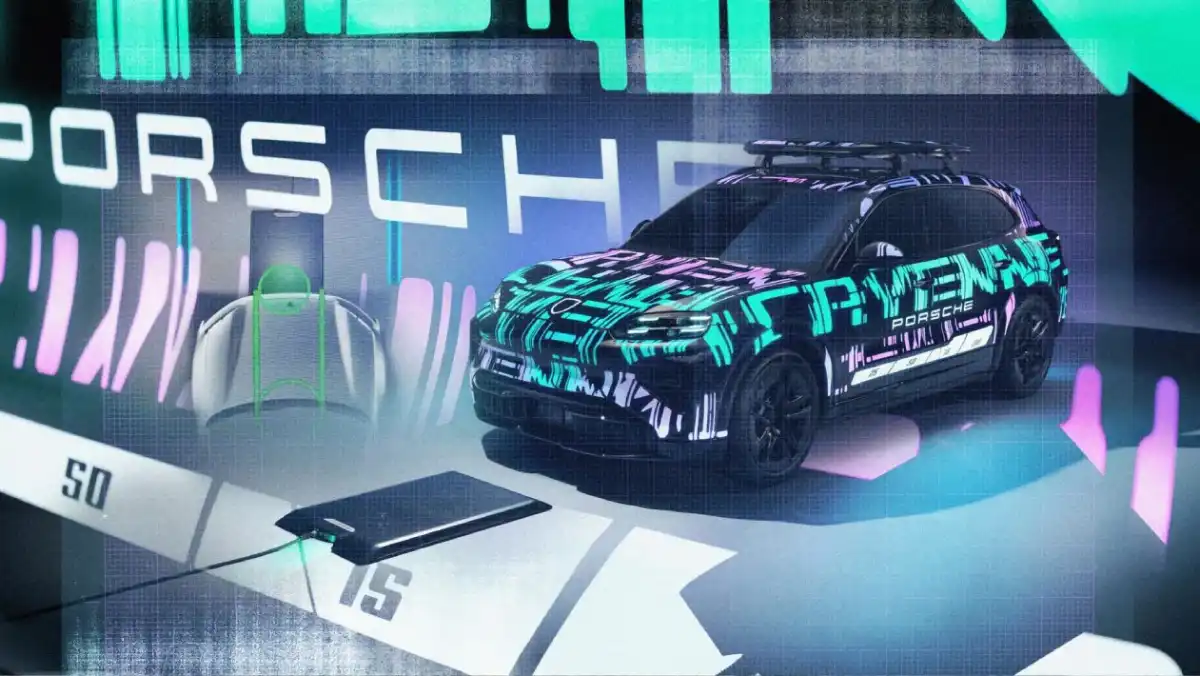
The idea of simply parking your car over a pad in the garage and having it start charging automatically, without touching a single cable, is no longer science fiction; the electric Porsche Cayenne is set to be one of the first cars to offer wireless charging as a factory‑approved, standards‑based option.
Despite the high price tag, the day‑to‑day convenience—especially for luxury‑car owners and drivers with reduced mobility—makes this technology a strong candidate to become a normal part of the charging ecosystem in the near future.
First: What is wireless charging for cars?
The core idea in simple terms
Wireless car charging relies on the same basic principle as Qi phone chargers: a coil in a ground pad generates an alternating magnetic field that transfers energy to a matching coil in the car.
The difference is that there is an air gap between pad and vehicle, so special techniques are used to minimise losses and raise efficiency to a level comparable with cable charging.
First major production application: the electric Cayenne
The electric Porsche Cayenne offers an optional wireless charging system rated at up to 11kW, the same power level as typical AC home wallboxes.
This means charging times are effectively similar to a cabled 11kW home setup, but the everyday experience is much smoother and simpler.
The SAE J2954 standard
The tech is no longer a collection of one‑off experiments; it now sits under an industry standard, SAE J2954, which defines operating frequency, power classes and how the car should be positioned over the pad.
A unified standard opens the door to ground pads that can work with multiple future models, instead of closed, brand‑specific systems.
Second: How does the system work from the moment you arrive?
The ground pad
The pad installed on the garage floor or parking bay contains copper coils supplied with alternating current, creating a magnetic field oscillating at around 85Hz as defined by the standard.
In standby mode, the pad runs at a very low power level, just enough to signal its presence without wasting significant energy.
Positioning: DIPS guidance
As the car approaches, sensors inside detect the pad’s weak field and use several small auxiliary coils to calculate its exact position using the Differential Inductive Positioning System (DIPS).
The car’s display then guides the driver—forward, back, left, right—into the optimal spot over the pad, after which charging can be enabled automatically.
Energy transfer from mains to battery
On the pad side, mains AC at 50Hz is first rectified to DC, then converted back to AC at around 85Hz to feed the ground coils.
In the car, the 85Hz current induced in the onboard coil is converted back into DC and fed directly into the high‑voltage battery through the vehicle’s own charging electronics.
Third: What about efficiency and safety?
Efficiency close to plug‑in charging
Porsche’s wireless system for the Cayenne promises 11kW with overall efficiency very close to conventional AC cable charging, so losses are not dramatically higher as many might fear.
Actual loss depends on how accurately the car is positioned over the pad and how large the air gap is, which is why air suspension can lower the vehicle slightly to reduce the distance between coils.
Safety for people and animals
The standard requires motion detection in the space between pad and vehicle; if an object—such as a pet or small child—moves into that gap, power is cut immediately.
There is also protection against stray metal objects that might otherwise heat up dangerously in the magnetic field, with the system shutting down if such items are detected.
Mechanical robustness
The ground pad must be physically armoured to withstand tyre loads, dirt, water and weather exposure if installed outdoors, without compromising performance or safety.
Fourth: Day‑to‑day advantages of wireless charging
Accumulated everyday convenience
Most EV charging happens at home or at a regular parking spot; saving a couple of minutes every time by not wrestling with a cable adds up to hours of convenience over years of ownership.
For owners used to “clean” premium experiences, getting rid of visible cables and wall‑boxes makes the garage look tidier and more in keeping with a high‑end car.
A big win for disabled drivers
Heavy cables and large plugs are a real obstacle for some drivers, particularly wheelchair users or anyone with limited strength or mobility.
Wireless charging turns the process into nothing more than parking accurately over the pad and letting the system take over, significantly boosting independence for these users.
Smart‑tariff integration
Because no one needs to physically plug in or unplug, the car can be programmed to start and stop charging automatically during cheap off‑peak hours, maximising savings on variable electricity tariffs.
Fifth: The challenges – why is it still so expensive?
High option price
On the electric Cayenne, the wireless option is expected to cost upwards of £5,000, covering the ground pad, onboard hardware and associated power electronics.
Much of the cost comes from complex electronics and the need for rugged, well‑insulated pad construction, as well as the fact that this is still an early‑stage, low‑volume technology.
No truly universal retrofit
Each EV has its own battery voltage and charging architecture, so you cannot simply bolt a generic pad under any car and expect safe, efficient charging.
True compatibility requires that the vehicle itself be designed at the factory with a receiver system matched to SAE J2954 and the manufacturer’s own integration.
Limited rollout at first
Like most new tech, wireless charging will debut in high‑margin premium models before gradually becoming cheaper and trickling down into more affordable segments as volumes rise and more suppliers enter the market.
Sixth: What does this mean for the future of EVs?
Laying the groundwork for “invisible” infrastructure
As the technology matures, it becomes possible to imagine public parking bays or even road sections fitted with hidden pads that top up cars while they are parked or, at low power levels, while they are moving.
This kind of background charging could reduce range anxiety by quietly replenishing energy in small, frequent doses without the driver doing anything.
Making EV ownership feel more like “just a car”
One of the biggest psychological barriers to EV adoption is the mental load of planning charging and dealing with cables; removing that friction moves EVs closer to the intuitive simplicity of refuelling a combustion car.
Wireless charging for electric cars does not aim to revolutionise the numbers on a spec sheet so much as it aims to revolutionise the ownership experience, targeting the most repetitive pain point in EV life: daily charging.
If manufacturers can bring costs down and broaden availability, this feature could evolve from a pricey extra on an electric Cayenne into an expected standard on mainstream EVs—much as phone wireless charging went from luxury gimmick to everyday convenience in less than a decade.