

- 1. L3 Autonomous Driving: From Pilots to Scale, Breakthroughs in Regulation and Production
- 2. Solid-State Battery: 400Wh/kg Vehicle Validation, Entering the 1,500km+ Range Era
- 3. 800V/1000V Ultra-Fast Charging: 400km in 5 Minutes, “Range Anxiety” Eliminated
- 4. Domestic ADAS Chips: Performance Leadership, Cost Reduction, Breaking Foreign Dominance
- 5. Intelligent Chassis Revolution: 800V Fully Active Suspension + Fully-By-Wire, Enabling “Human-Machine Co-Driving Native”
- 6. Future 1-3 Years: Application Prospects of Five Technologies in the Middle East
- 7. Frequently Asked Questions (FAQ)
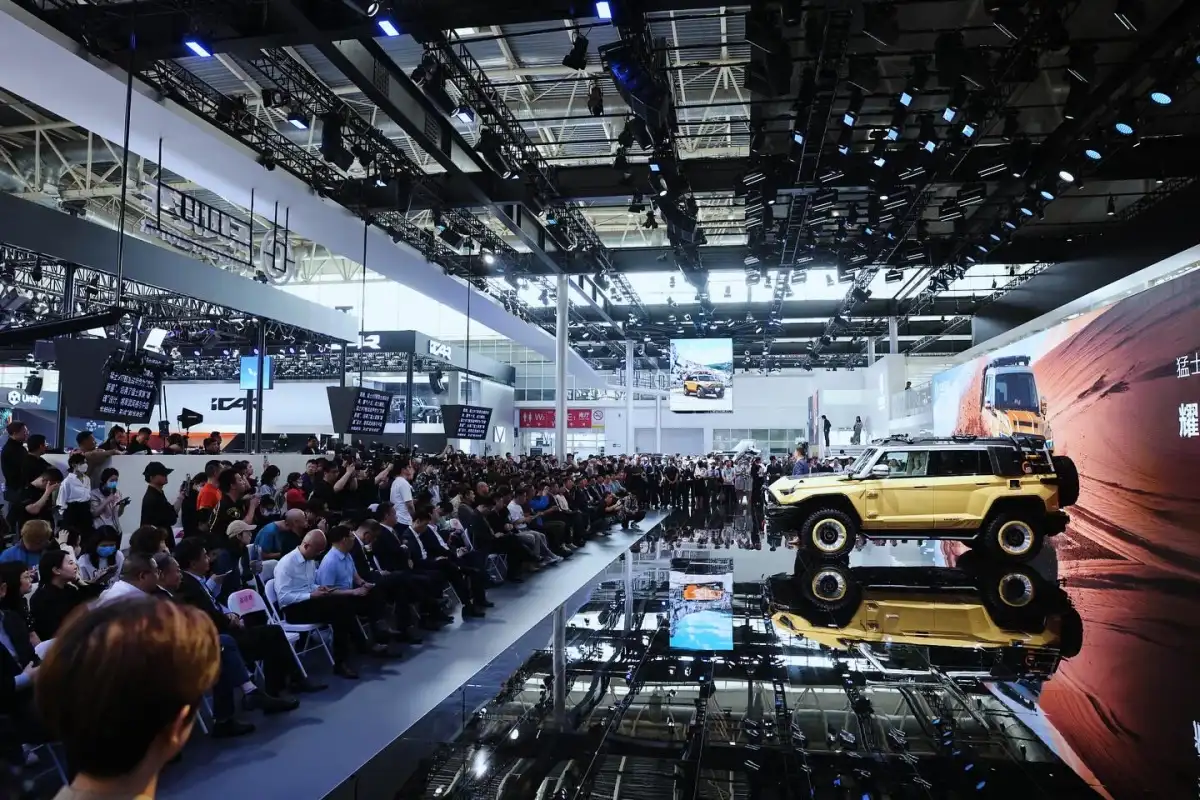
April 24, 2026, Beijing – The 19th Beijing International Automotive Exhibition opens with a record 380,000 sqm across two venues. The highlight is the large-scale production deployment of full-stack intelligent technologies – L3 ADAS, large-model cockpits, solid-state batteries, and 800V/1000V platforms are no longer concepts but are now standard on production vehicles. In Q1 2026, China‘s auto exports exceeded 1.8 million units, up 25% YoY, with NEVs accounting for over 40%, providing strong industrial support for the Beijing Auto Show’s global positioning. For the Middle East, every core technology showcased will profoundly influence car buyers‘ choices in the UAE, Saudi Arabia and beyond over the next 3-5 years.
 1. L3 Autonomous Driving: From Pilots to Scale, Breakthroughs in Regulation and Production
2026 is recognized as the first year for L3 autonomous driving to move from pilot to mass adoption. 23 cities in China have opened legal sections of highways/expressways for L3, with clear “10-second takeover” rules and OEM liability. This policy momentum has translated into real production achievements at the Beijing Auto Show.
Mass-production models debut: The new AITOUAE AITOBahrain AITOEgypt AITOKSA AITOKuwait AITOOman AITOQatar AITO M9 has obtained L3 certification, featuring 6 LiDAR units (including an 896-line image-grade main LiDAR). The Li Auto L9KSA Li Auto L9UAE Li Auto L9Bahrain Li Auto L9Egypt Li Auto L9Kuwait Li Auto L9Oman Li Auto L9Qatar Li Auto L9 Livis is equipped with two 5nm self-developed Mach 100 chips delivering 2,560 TOPS and 4 LiDARs providing 360° coverage. BMWUAE BMWEgypt BMWBahrain BMWKSA BMWKuwait BMWOman BMWQatar BMW and Mercedes also unveiled L3 systems aligned with Chinese standards.
Cost reduction: Urban NOA solutions based on Horizon Journey 6M have secured OEM contracts, with mass production in Q3 2026. LiDAR prices have dropped from 3,000-5,000 RMB to the 1,000 RMB level, and ADAS chip costs per vehicle have been reduced by 30%.
 2. Solid-State Battery: 400Wh/kg Vehicle Validation, Entering the 1,500km+ Range Era
Solid-state batteries are the most anticipated frontier technology at this auto show, with multiple players showcasing progress from lab to production.
Clear timelines: ChanganBahrain ChanganEgypt ChanganKSA ChanganKuwait ChanganOman ChanganQatar ChanganUAE Changan Auto announced all-solid-state battery vehicle validation in 2026 and mass production in 2027, with 400Wh/kg energy density and 1,500km+ range. DongfengBahrain DongfengEgypt DongfengKSA DongfengKuwait DongfengOman DongfengQatar DongfengUAE Dongfeng‘s 350Wh/kg solid-state battery has completed extreme environment testing (-40°C to 60°C) and will enter mass production in September 2026. Taly New Energy displayed an all-solid-state battery with a claimed 720Wh/kg energy density.
Key advantages: Solid-state batteries use inorganic solid electrolytes, offering thermal stability far beyond liquid lithium-ion batteries, operating reliably from -50°C to 200°C. In 50°C+ heat, range degradation is kept below 5% (compared to 20%-30% for traditional ternary lithium batteries), making them naturally suited for the Middle Eastern desert climate.
Multiple technology paths: BYDEgypt BYDUAE BYDKSA BYDBahrain BYDKuwait BYDOman BYDQatar BYD showcased its second-gen Blade Battery paired with a full-domain 1000V platform supporting 1,500kW megawatt flash charging (400km in 5 minutes). GACUAE GACBahrain GACEgypt GACKSA GACKuwait GACOman GACQatar GAC, CheryKSA CheryKuwait CheryQatar CheryBahrain CheryUAE CheryOman CheryEgypt Chery and others displayed 800V platforms and sodium-ion battery technology.
3. 800V/1000V Ultra-Fast Charging: 400km in 5 Minutes, “Range Anxiety” Eliminated
Ultra-fast charging has become another core highlight. BYD, XpengKSA XpengUAE XpengBahrain XpengEgypt XpengKuwait XpengOman XpengQatar Xpeng, GeelyUAE GeelyKSA GeelyKuwait GeelyQatar GeelyOman GeelyBahrain GeelyEgypt Geely and GWM all displayed mass-production 800V/1000V solutions.
BYD Megawatt Flash Charging 2.0: Full-domain 1000V platform with 1,500kW peak power, adding 400km range in 5 minutes. BYD commits to 20,000 flash charging stations by end-2026.
Xpeng 5C Ultra-Fast Charging: 2026 G9 features standard 800V platform + 5C AI battery, adding 300km+ in 12 minutes.
Liquid cooling for high temperatures: BYD’s flash charging stations use liquid cooling technology, already tested in Turpan, China (80°C+ ground temperature), ensuring stable output – critical for Middle East deployment.
4. Domestic ADAS Chips: Performance Leadership, Cost Reduction, Breaking Foreign Dominance
Domestic ADAS chips have achieved a breakthrough at this auto show, moving from “following” to “leading”.
Flagship chips debut: Horizon Journey 6P (560 TOPS), Black Sesame A2000 (7nm, single chip >1000 TOPS), and SemiDrive X9 series. Li Auto’s dual self-developed Mach 100 chips (2,560 TOPS total) deliver triple the effective computing power of NVIDIA Thor-U.
Mass production drives volume market: The Journey 6M chip will see explosive production in 2026, with over 50 new models expected, bringing high-level ADAS into the 100,000 RMB price segment. Bosch’s mid-level ADAS solution based on a single Journey 6M has won 10+ model contracts from 5 OEMs.
5. Intelligent Chassis Revolution: 800V Fully Active Suspension + Fully-By-Wire, Enabling “Human-Machine Co-Driving Native”
Chassis technology has undergone a comprehensive revolution, evolving from independent mechanical components to an “intelligent collaborator” deeply integrated with ADAS and powertrain.
Li Auto L9 Livis: 800V fully active suspension with over 10,000 newtons of lifting force per wheel, eliminating the need for an anti-roll bar, providing millisecond response. World‘s first production “full-body” fully-by-wire chassis integrating steer-by-wire, four-wheel steering and the world’s first fully electronic mechanical braking (EMB) system.
AITO M9: Huawei Turing intelligent chassis with intelligent adjustable air suspension and CDC, featuring fully active suspension.
NIO ES9: Tianxing intelligent chassis with steer-by-wire, rear-wheel steering and fully active suspension.
Middle East value: These technologies can deliver OTA-updated “desert mode”, lowering suspension stiffness, increasing ground clearance, and enabling “one-click drift” for sand driving, as well as “highway stability mode” for crosswind resistance on coastal roads.
6. Future 1-3 Years: Application Prospects of Five Technologies in the Middle East
The Middle East has summer temperatures exceeding 50°C, with charging networks dominated by slow AC chargers (over 65% in the UAE). The technologies showcased at this auto show naturally address local needs. Chinese brands are shifting from “product export” to “technology standard export”. Over the next 1-3 years, Middle Eastern consumers will directly benefit in the following dimensions:
L3 ADAS local adaptation: The UAE has issued its Autonomous Vehicles Guide, and Dubai aims for 25% of trips to be automated by 2030. Chinese L3-capable models (AITO M9, Li L9) will undergo OTA local training to adapt to the region’s mixed road conditions. By 2027-2028, major Middle Eastern cities are expected to open specific areas for L3.
Ultra-fast charging network: BYD‘s liquid-cooled flash chargers have passed extreme heat testing. Future Middle East deployment will combine liquid-cooled cables, active fan cooling and solar panel canopies. Abu Dhabi has launched a “Green Bus” ultra-fast charging network initiative.
Solid-state battery heat resilience: With range degradation below 5% at 50°C+, solid-state batteries will enter the Middle East in 2026-2027, offering “no range exaggeration in summer” for the first time.
ADAS algorithm localization: Domestic chips support OTA perception model updates, enabling rapid optimization for local scenarios like sandstorms, faded lane markings, and camel/sheep crossings. Vehicles with Journey 6P can automatically switch to “radar+infrared” fusion perception during sandstorms.
Intelligent chassis desert mode: 800V fully active suspension and four-wheel steering can deliver OTA-updated “desert mode” and “highway stability mode”, debuting on Tank 700, Mengshi 917 and other models already in the Middle East.
💡Check real-time inventory and quotes for new Beijing Auto Show models in the Middle East on the cartea App – Click here (placeholder link)
7. Frequently Asked Questions (FAQ)
Q: What are the five most important technology trends at the 2026 Beijing Auto Show?
A: L3 autonomous driving mass production; solid-state battery vehicle validation (400Wh/kg, 1,500km+ range); 800V/1000V ultra-fast charging (400km in 5 minutes); domestic ADAS chips exceeding 1,000 TOPS; intelligent chassis with full-by-wire + fully active suspension.
Q: When will these technologies be available in the Middle East?
A: L3 ADAS is expected to be available in major Middle Eastern cities by 2027-2028. Solid-state batteries will enter the Middle East in 2026-2027. Ultra-fast charging networks will take 2-3 years to build. However, Chinese brand models (AITO M9, Li L9, Tank 700, etc.) are already on sale or coming soon to the Middle East, with some technologies (800V platform, intelligent chassis) already arriving.
Q: Can 800V ultra-fast charging work reliably in 50°C Middle Eastern heat?
A: Yes. BYD‘s liquid-cooled flash chargers have passed extreme heat testing in Turpan, China (80°C+ ground temperature). Middle East deployment will combine liquid cooling, active fan cooling and solar panel canopies to ensure charging efficiency.
Q: What are the advantages of solid-state batteries over traditional batteries in the Middle East?
A: Solid-state batteries use inorganic solid electrolytes with extremely high thermal stability. In 50°C+ heat, range degradation is just 5% (compared to 20%-30% for traditional ternary lithium batteries), and they do not suffer from thermal runaway, making them ideal for desert climates.
Q: How is after-sales service for Chinese brand EVs in the Middle East?
A: Chinese automakers are accelerating “system-level globalization.” GWM has over 1,400 overseas channels; Dongfeng Mengshi has established mature service networks in multiple Middle Eastern countries; 212 off-road vehicles is building regional parts centers and local KD plants. Check specific brands‘ dealer networks and parts availability on the cartea App.