

- A surprise in the shape of a Beetle
- Tesla heart, Porsche batteries: an unusual recipe
- Performance numbers that embarrass supercars
- Range and real‑world usability
- Chassis and brakes: upgraded the Porsche way
- Exterior design: classic Beetle looks hiding a secret
- Interior: blending originality with sportiness
- An 8,000‑km journey to prove it’s more than a showpiece
- A simple comparison with the Porsche 911 GT3
- A little story from the road
- More than just a “tuned car”
This classic Beetle might look from a distance like any ordinary old Volkswagen from a simpler era, but in reality it’s an extreme project that blends Tesla and Porsche hardware inside a humble people’s car body. Beneath that cute, rounded roof hides more than 600 electric horsepower and a 0–100 km/h time of just 2.9 seconds, making it quicker to 60 mph than a modern Porsche 911 GT3 and close to the numbers of some Lamborghinis.
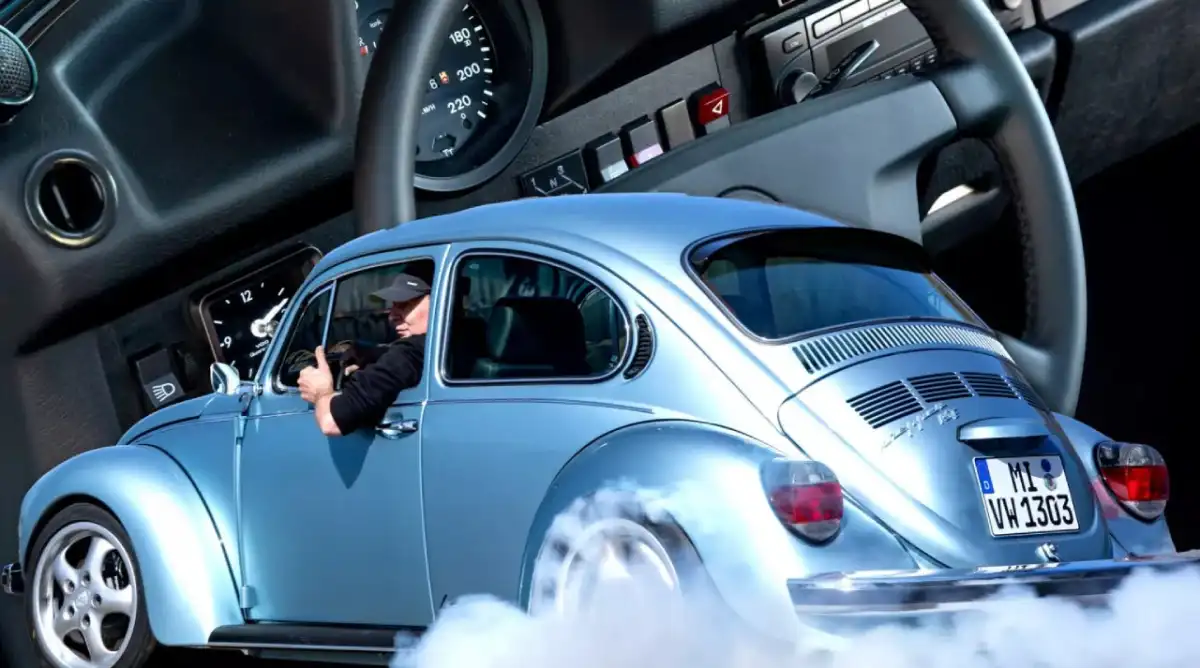
A surprise in the shape of a Beetle
The story of this car began in a California scrapyard, where a tired, abandoned VW Beetle was found in a state that gave no hint of what it would eventually become. It was bought, shipped to Germany, and handed over to the specialists at Knepper Bugs & More. Instead of restoring it the typical way with an air‑cooled boxer engine, they chose to turn it into a fully electric restomod that could compete with, and even out‑drag, modern supercars.
The aim was not simply to save a classic Beetle, but to create a car that combines the look of the past with the performance of the future, proving that electrification can turn a “quiet village car” into a silent monster capable of humiliating legendary sports machines.
Tesla heart, Porsche batteries: an unusual recipe
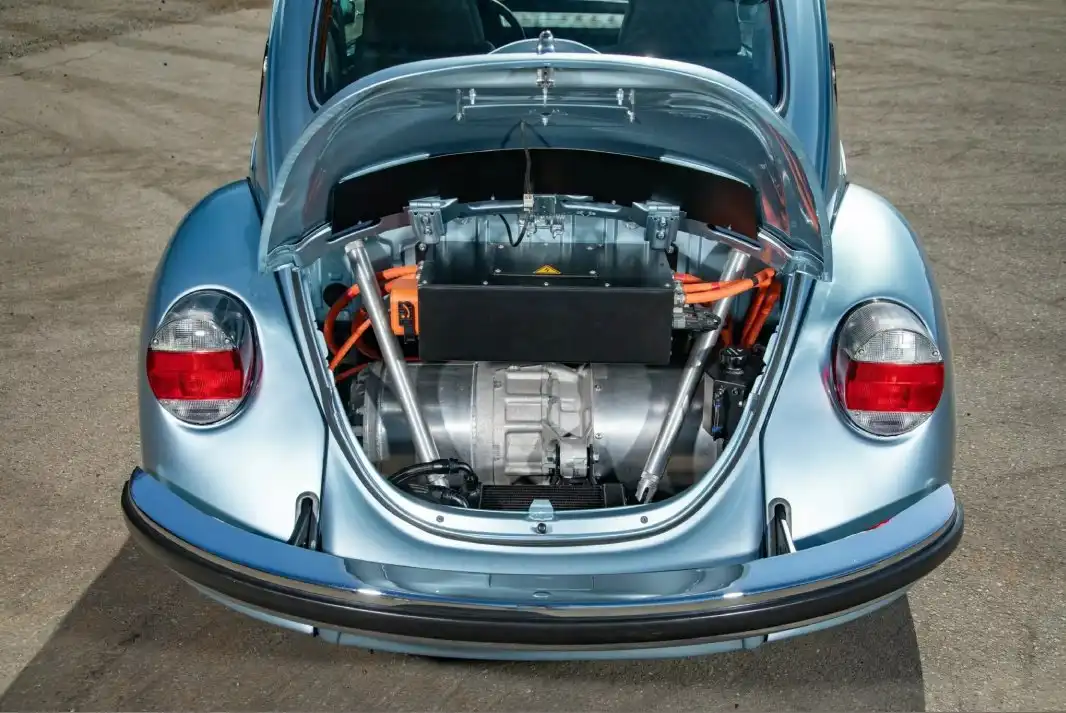
The original powertrain was removed entirely and replaced by the rear‑axle drive unit from a Tesla Model S.
The system was modified to run at a higher voltage than stock, pushing output to over 600 hp and around 700 Nm of torque, roughly three times the power of some modern hot hatches.
Energy is stored in 17 battery modules sourced from a Porsche Taycan, meaning the car benefits from cells originally designed for a high‑performance electric sedan.
Porsche 930 driveshafts handle the job of transferring that huge torque to the rear wheels reliably.
With this mix, the Beetle becomes an “electric Frankenstein” that merges Tesla engineering, Porsche batteries, and classic Volkswagen styling into one coherent package.
Performance numbers that embarrass supercars
The sprint from 0 to 100 km/h takes just 2.9 seconds, firmly pushing this Beetle into genuine supercar territory.
For context, a modern Porsche 911 GT3 needs roughly 3.4 seconds to cover the same sprint, while some new hybrid Lamborghinis sit around 2.7 seconds. In other words, the Beetle is very much playing in that league.
With this level of acceleration, any traffic‑light start or highway on‑ramp becomes an opportunity to show that a classic silhouette doesn’t mean old‑fashioned performance.
What makes it even more striking is that everything happens in near silence: no screaming flat‑six, no roaring exhaust, just a brief chirp of the tires and a steering wheel busy coping with a tsunami of torque.
Range and real‑world usability
Despite the focus on straight‑line performance, practicality wasn’t completely ignored:
Driven gently, the car can cover about 250 km on a full charge, which is impressive for a custom restomod of this kind.
When driven hard and used as intended—full launches, aggressive acceleration—the range drops to around 100 km, which is expected for a build centered on thrills rather than commuting.
This puts it squarely in the “weekend toy” category: ideal for short trips, coffee runs, car meets and spirited drives, followed by an overnight charge before the next outing.
Chassis and brakes: upgraded the Porsche way
Power alone isn’t enough, so the surrounding hardware had to be brought up to the same level:
Many of the suspension and braking components come from a Porsche 944, a car well known for its balance and handling.
Components from respected suspension brands such as KW and Bilstein were used to fine‑tune the car’s behavior and ensure it can safely handle its new performance envelope.
The result is a Beetle that remains light and nimble in corners, yet is also capable of coping with the acceleration and deceleration of a serious sports car.
In practice, that means this is not just a straight‑line rocket; it can turn, stop, and behave with surprising composure when the road gets twisty.
Exterior design: classic Beetle looks hiding a secret
From the outside, the team resisted the temptation to spoil the classic character of the Beetle:
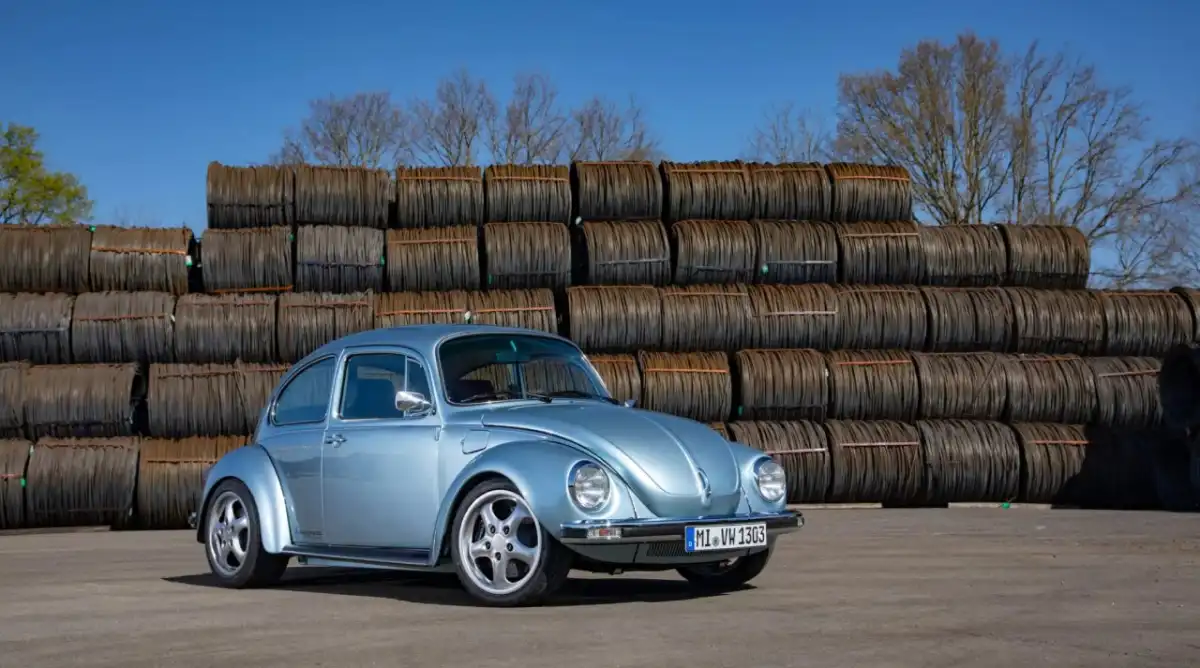
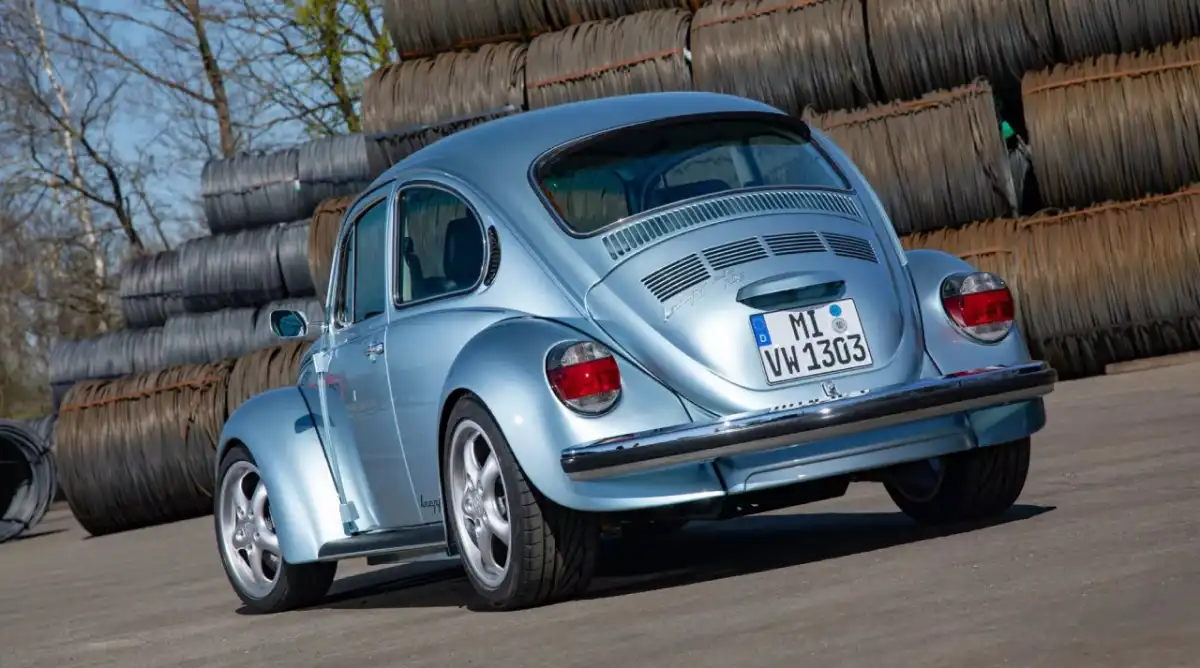
The body was fully restored and finished in a beautiful shade of Marathon Blue that underlines its vintage charm.
The car sits on classic Porsche wheels, with the ride height lowered to give it a more aggressive stance without looking cartoonish or overdone.
A small carbon fiber rear spoiler was added to complement the look, but it remains subtle enough not to distract from the original lines.
To most passers‑by, it’s just a clean, nicely restored Beetle—right up until the driver floors the throttle and the illusion disappears.
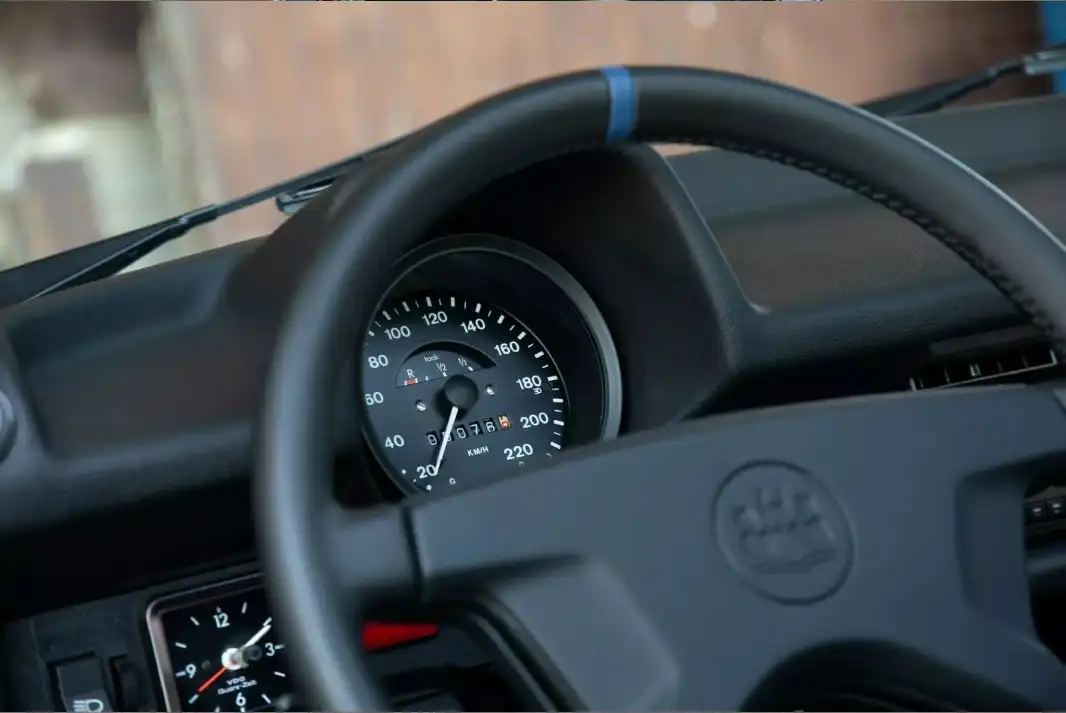
Interior: blending originality with sportiness
Inside, the approach was to mix simplicity with purposeful upgrades:
The original dashboard and speedometer were restored, keeping the familiar look Beetle fans expect.
The seats were replaced with Recaro units taken from a BMW 2002, adding better lateral support and bringing in another touch of classic German sportiness.
The traditional gear lever is gone, replaced by a small digital interface for selecting drive or reverse, in line with the nature of the electric powertrain.
The cabin therefore looks, at first glance, like a neat classic interior, before the details reveal that this is anything but a stock Beetle.
An 8,000‑km journey to prove it’s more than a showpiece
To prove that this car is not just a static show car, the builders took it on a long, demanding road trip of over 8,000 km:
The route included several European countries such as Belgium, France, Spain, Portugal, and Luxembourg.
The adventure even extended across the Strait of Gibraltar into North Africa, clearly demonstrating their confidence in the reliability of the build.
A journey like this reassures any potential buyer or follower that this project can handle real‑world conditions, not just produce impressive acceleration figures on paper.
A simple comparison with the Porsche 911 GT3
One of the easiest ways to explain this car’s impact is to compare it mentally with a modern Porsche 911 GT3:
The GT3 is engineered from the ground up as a track‑focused icon and dream car for performance enthusiasts.
The Beetle, in contrast, was born as a basic people’s car, cheap and simple transportation.
Yet, thanks to its electric conversion, the Beetle can beat the GT3 off the line, showing how modern EV technology can completely flip the traditional performance hierarchy in the car world.
A little story from the road
You can imagine the scene on a highway:
A small blue Beetle pulls up next to a modern Porsche at a traffic light. The driver of the Porsche smiles, history on his side.
The light turns green, both cars launch, but the Beetle jumps forward with a silent surge, gains a clear lead, and keeps pulling away until the Porsche shrinks in its rearview mirror.
At the next stop, curious onlookers gather and ask, “What did you do to that Beetle?” The answer can be summed up in three names: Tesla, Porsche, Volkswagen.
More than just a “tuned car”
This Beetle is not merely a fast modified classic; it’s a design and engineering statement about the future—about how heritage, performance, and electrification can coexist in one package.
It sends a clear message: classic cars don’t have to retire to museums and weekend shows. With the right vision, they can return to the road with modern power, honoring their past while confidently challenging the best that today’s supercar world has to offer.