
- Testing Identity Before Testing Technology
- The Name and the Philosophy: “Luce” Is More Than a Label
- Luce’s Position Within Ferrari’s Lineup
- Structure and Architecture: A Clean-Sheet Engineering Approach
- Electric Powertrain: Numbers Worthy of the Badge
- Battery Technology: A Silent Heart Built Like a Race Component
- The Cabin: Putting the Human Back at the Center
- Sound: Ferrari Refuses Total Silence
- Suspension and Vehicle Control
- Why Luce Truly Matters
- Can Ferrari Succeed in a Fuel-Free World?
Testing Identity Before Testing Technology
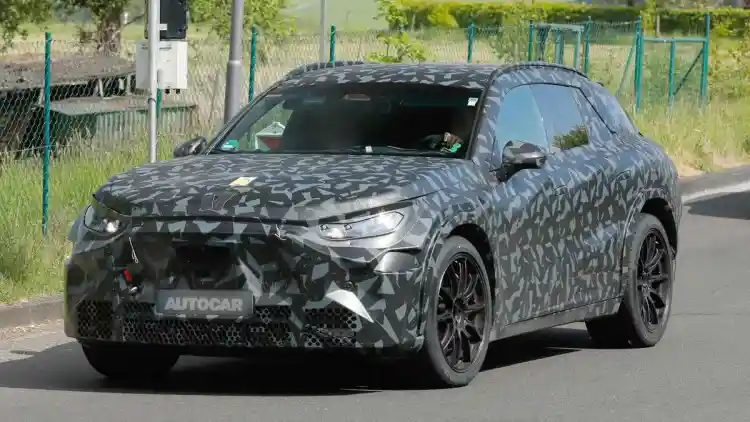
When Ferrari officially announced its first fully electric project under the name Luce, the most important question was not about numbers or battery range, but about identity.
How can a brand built on sound, vibration, and pure mechanical emotion enter a silent world ruled by electrons?
Ferrari understands that its move into electrification is unlike that of any other manufacturer. This is not simply the launch of a new model, but a redefinition of what Ferrari means in a fuel-free era.
The Name and the Philosophy: “Luce” Is More Than a Label
The name Luce means “light” in Italian, and it is a carefully chosen word.
Ferrari does not present its electric car as a compromise with the past, but as:
A light guiding the future
A conceptual transition before a technical one
The beginning of a new chapter, not a break from heritage
The message is clear: electricity is not a forced substitute, but a new tool for expressing performance and passion.
Luce’s Position Within Ferrari’s Lineup
Ferrari has confirmed that Luce:
Is not a replacement for V12 or V8 models
Does not signal the end of internal combustion engines
Is not a side experiment
Instead, Luce represents a new independent pillar within Ferrari’s lineup, standing alongside:
Traditional sports cars
Hybrid models
High-performance flagships
In other words, Luce is not “the Ferrari of the future,” but one of Ferrari’s futures.
.jpg?x-oss-process=image/format,webp/interlace,1/quality,q_60/resize,w_1200)
Structure and Architecture: A Clean-Sheet Engineering Approach
Luce is built on a fully bespoke electric platform developed entirely in Maranello, not a shared or adapted architecture.
Key highlights include:
More than 60 patents linked to the platform
75% recycled aluminum used in the structure
A reduction of approximately 6.7 tons of CO₂ emissions per car during manufacturing
A design balancing rigidity with weight optimization
Weight and the Real Challenge
Despite these efforts, Luce weighs around 2,300 kg, a high figure by Ferrari standards.
Ferrari counters this with:
An extremely low center of gravity
Carefully engineered weight distribution
An advanced active suspension system
The goal is to turn mass into a dynamic advantage rather than a liability.
Electric Powertrain: Numbers Worthy of the Badge
Luce uses dual electric axles, one at the front and one at the rear, drawing directly from Ferrari’s Formula 1 expertise.
Preliminary Performance Figures
Element | Details |
|---|---|
Front axle output | 282 hp |
Rear axle output | 831 hp |
Wheel torque | Up to 8,000 Nm |
0–100 km/h | Around 2.5 seconds |
Top speed | Approximately 310 km/h |
Electrical system | 800-volt architecture |
These figures place Luce firmly among ultra-high-performance electric cars, not merely a luxury electric GT.
Battery Technology: A Silent Heart Built Like a Race Component
Ferrari is developing the battery system in-house, focusing on:
High energy density, reaching 305 Wh/kg
An 800-volt system for faster charging and higher efficiency
Sophisticated thermal management capable of sustained hard driving
Expected Driving Range
The projected range is around 530 km, a deliberately balanced figure considering:
The vehicle’s performance level
Its mass
Its intended driving character
Ferrari prioritizes consistent performance over inflated theoretical range claims.
The Cabin: Putting the Human Back at the Center
One of Luce’s most distinctive elements is its interior, developed in collaboration with:
Jonathan Ive, former Apple design chief
Industrial designer Marc Newson
Interior Philosophy
Rejecting full touchscreen dominance
Reintroducing physical buttons and tactile controls
Maintaining a strong sensory and visual focus on the driver
Key Interior Elements
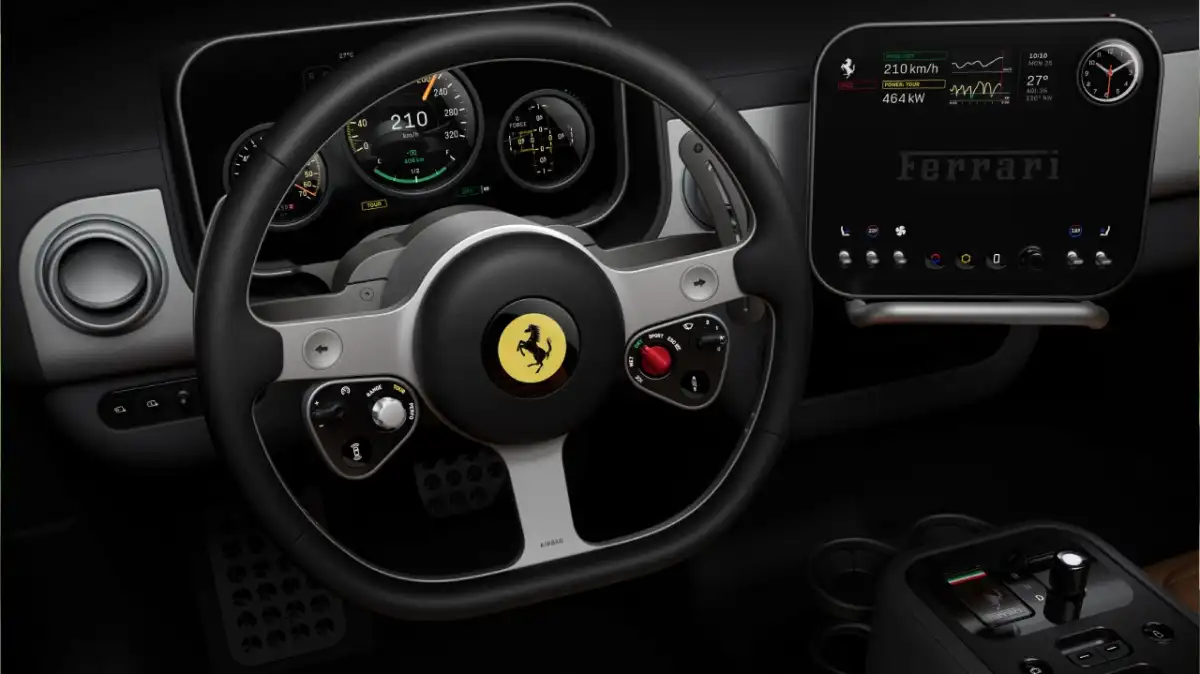
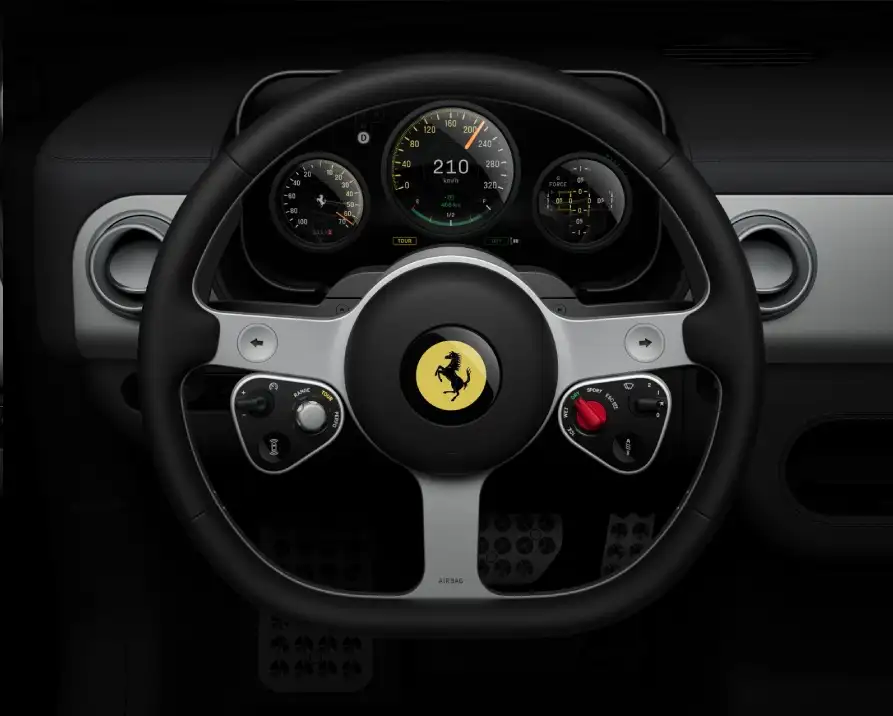
Multi-layer OLED instrument displays
A three-spoke steering wheel inspired by classic Ferrari models
Lightweight, high-quality materials
A user interface designed to reduce distraction and restore engagement
Ferrari wants the driver to feel they are operating a machine, not a tablet.
Sound: Ferrari Refuses Total Silence
Ferrari has clearly stated that it will:
Not use traditional artificial engine sounds
Not leave the experience completely silent
Instead, Luce employs an innovative sound system based on:
Rear axle vibrations
Real frequencies captured by high-precision sensors
Acoustic modulation inside the cabin
The result is expected to be a functional, living sound, more like a musical instrument than a synthetic recording.
Suspension and Vehicle Control
Advanced 48-volt active suspension system
Real-time traction management
Intelligent torque distribution between axles
High-precision electric steering
The objective is clear: offset weight and deliver a genuinely Ferrari-like driving feel.
Why Luce Truly Matters
Luce matters not because it is electric, but because it:
Tests the boundaries of Ferrari’s identity
Rejects easy, generic solutions
Attempts to transfer emotion rather than replace it
It is as much a philosophical project as it is an engineering one.
Can Ferrari Succeed in a Fuel-Free World?
Ferrari Luce is not trying to please everyone. It is trying to remain honest to itself.
If the early figures and design philosophy translate into reality, Luce could become:
The first electric car that truly feels like a Ferrari
Not just an electric vehicle wearing a famous badge
The final answer will come with the full unveiling, but one thing is already clear: Maranello is entering the future without hesitation.


.webp?x-oss-process=image/format,webp/interlace,1/quality,q_70/resize,w_750)