
- Geely’s New Direction Comes Into Focus at Auto China 2026
- A Robotaxi That Reflects a Broader Strategy
- G-ASD: Moving Beyond Conventional Driver Assistance
- Hybrid Technology Tailored for Real-World Markets
- Expanding the Product Portfolio for the GCC
- Entering New Segments: Off-Road and Performance
- What It Means for the UAE Market
Geely’s New Direction Comes Into Focus at Auto China 2026
At Auto China 2026, GeelyUAE GeelyKSA GeelyKuwait GeelyQatar GeelyOman GeelyBahrain GeelyEgypt Geely is no longer presenting itself as a fast-growing automaker. It is positioning itself as a technology-led mobility company with a clear global strategy, and the Gulf region sits firmly within that vision.
Rather than focusing on individual vehicle launches, Geely’s presence in Beijing revolves around an integrated ecosystem that combines intelligent driving, advanced hybrid systems, and scalable platforms designed for international markets, including the UAE and Saudi Arabia.

A Robotaxi That Reflects a Broader Strategy
Among the most closely watched reveals is Geely’s internally developed robotaxi prototype. While autonomous mobility is not new in China, the significance here lies in vertical integration. Unlike competitors relying on external partnerships, Geely is showcasing a system built around its own hardware, software, and data architecture.
The platform is powered by a high-performance computing system based on next-generation chips from NVIDIA, supported by a multi-sensor perception suite that includes LiDAR and vision-based inputs. More importantly, it is tied directly to Geely’s production ecosystem, suggesting that elements of this technology will gradually filter into consumer vehicles rather than remaining confined to pilot programs.
For GCC markets, the relevance is indirect but important. Fully autonomous mobility may still be years away from widespread deployment, but the underlying driver-assistance technologies are already shaping the next generation of premium vehicles entering the region.

G-ASD: Moving Beyond Conventional Driver Assistance
At the core of this push is Geely’s G-ASD system, an AI-driven platform designed to unify perception, decision-making, and vehicle control. Unlike traditional ADAS setups that rely heavily on pre-mapped environments, this system is built to operate with a higher degree of independence, enabling features such as map-free navigation and full journey automation under specific conditions.
The system’s development is based on large-scale data training, a key factor in improving real-world reliability. While some of the company’s data claims remain difficult to independently verify, the direction reflects a broader industry shift toward AI-native driving systems rather than incremental ADAS upgrades.

Hybrid Technology Tailored for Real-World Markets
While much of the global conversation remains centered on full electric vehicles, Geely is placing equal emphasis on hybrid systems, particularly for markets where infrastructure remains a limiting factor.
Its latest i-HEV powertrain represents a significant step forward in efficiency. With a claimed thermal efficiency exceeding 48 percent, it sits among the most advanced hybrid systems currently in production. More importantly, it enables extended electric driving in urban environments while maintaining the flexibility of a combustion engine for long-distance travel.
This balance is particularly relevant in the GCC, where long highway journeys and high temperatures continue to challenge full EV adoption. In this context, advanced hybrids offer a more practical bridge between conventional engines and fully electric mobility.
Expanding the Product Portfolio for the GCC
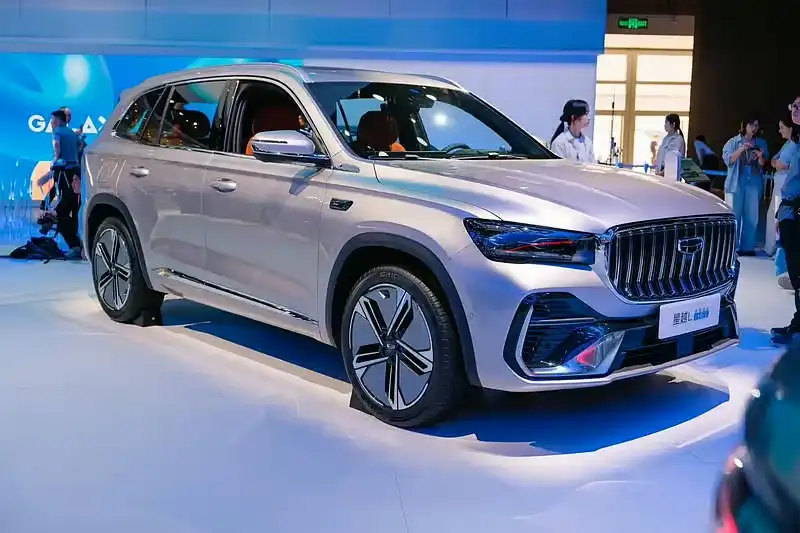
Geely’s broader strategy extends beyond technology into product planning. The company is preparing a wave of new-energy vehicles for the region, supported by a growing presence of its sub-brands, including ZeekrBahrain ZeekrEgypt ZeekrKSA ZeekrKuwait ZeekrOman ZeekrQatar ZeekrUAE Zeekr and Lynk & Co.
At the same time, updates to existing models such as the Monjaro indicate a shift toward more premium positioning. Improvements in ride comfort, in-cabin technology, and driver assistance systems reflect a clear intent to compete more directly with established European brands in the UAE market.
Entering New Segments: Off-Road and Performance
Geely is also exploring segments that have traditionally been dominated by other manufacturers. The introduction of a rugged SUV concept signals an awareness of regional preferences, particularly in markets where off-road capability remains a key purchasing factor.
In parallel, the company’s involvement in touring car racing under its own name marks an effort to build a stronger performance identity. This move is less about immediate sales impact and more about reshaping brand perception on a global scale.
What It Means for the UAE Market
The version of Geely emerging from Auto China 2026 is markedly different from its earlier global image. It is more confident technologically, more ambitious in its positioning, and more deliberate in its regional strategies.
For the UAE, this translates into a new wave of vehicles that are not only competitively priced but also increasingly aligned with local expectations in terms of performance, technology, and usability.
Rather than treating the GCC as a secondary market, Geely is now designing its expansion with the region in mind. That shift alone may prove to be one of the most significant developments to come out of Beijing this year.