

- When Newey’s dreams become reality
- Exterior design: air sculpted around the car
- Cabin: Le Mans prototype spirit, without distracting screens
- Engine and drivetrain: a V10 screaming to 15,000rpm
- Aerodynamics and downforce: 1,700kg of “suction”
- Newey’s role and Red Bull’s backstage work
- Who is the RB17 for?
When Newey’s dreams become reality
Adrian Newey may have left Red Bull for Aston Martin, but his fingerprints are still all over the RB17 project, a hardcore track‑only hypercar that looks like a Formula 1 car wrapped in a sleek carbon body.
This car, refined over years of obsession with aerodynamics and weight saving, now returns in its near‑final form with visible design changes and a stunning powertrain that combines a high‑revving V10 with a compact hybrid system for extra electric shove.

Exterior design: air sculpted around the car
Bolder, more expressive face
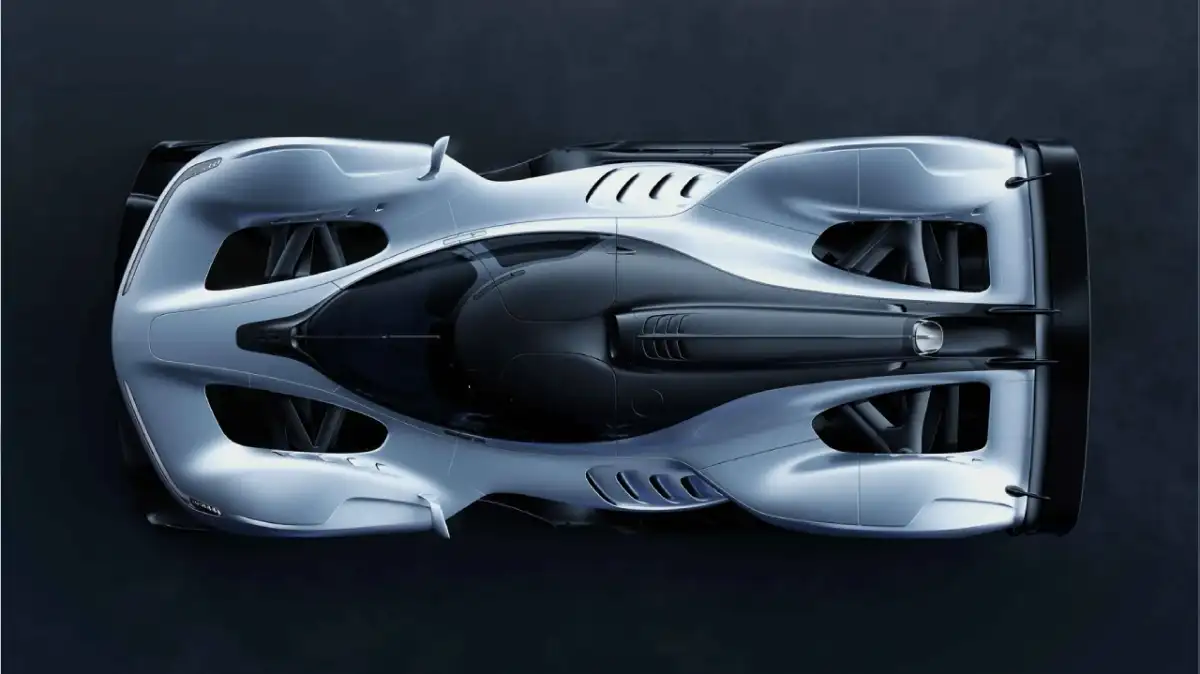
New hockey‑stick LED headlights give the front end a “face” after the original prototype’s more brutal, abstract look.
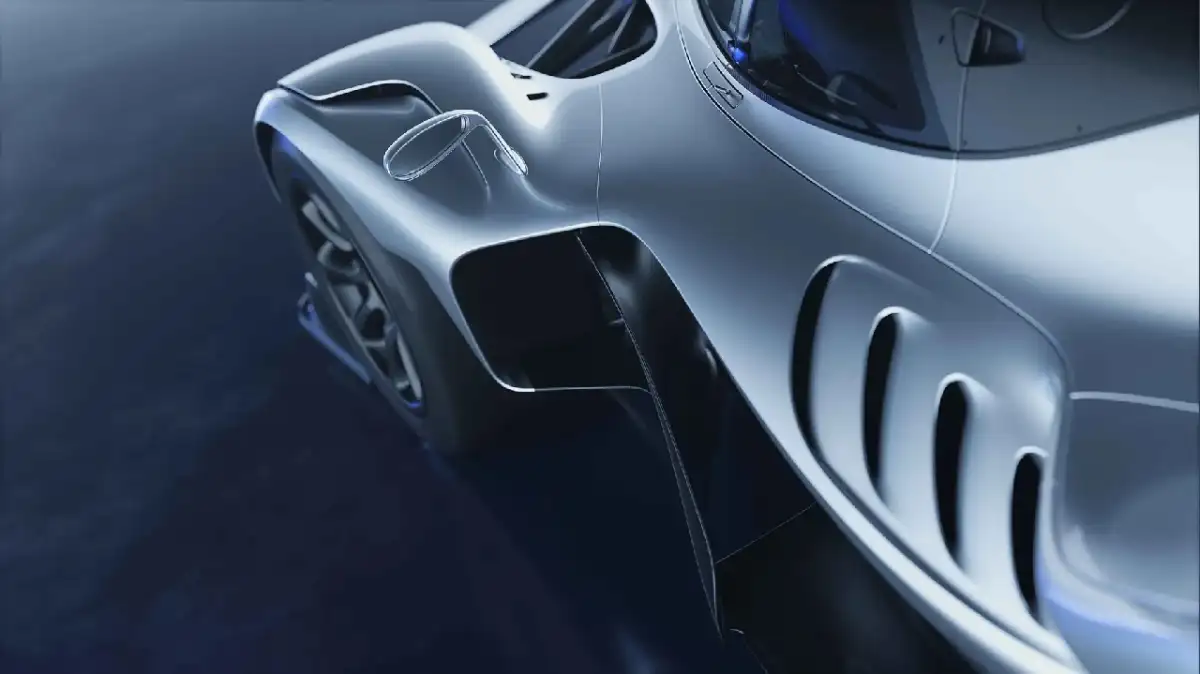
Reworked cooling vents and ducting signal a fresh round of work on thermal management and airflow through the body.
Fins and silhouette shaped by speed
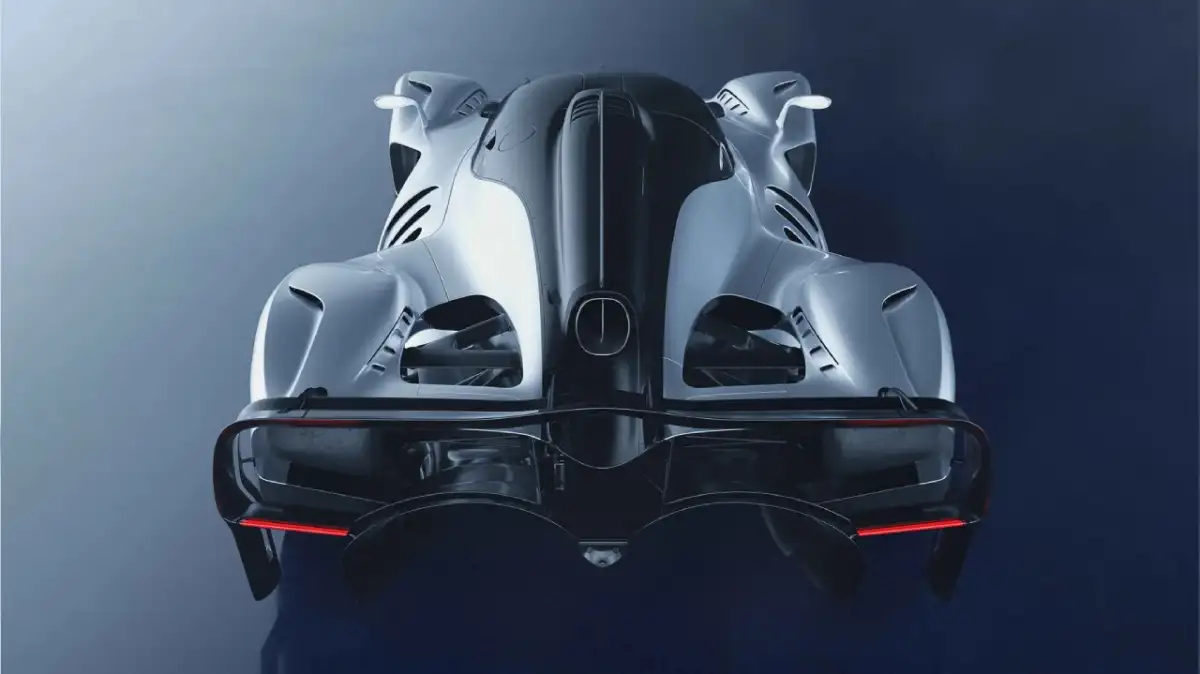
The rear engine cover gains a huge sail‑like fin, reminiscent of a swordfish, adding high‑speed stability and a very race‑car‑like attitude.
Overall dimensions are marginally smaller than before, while the footprint still closely matches a modern F1 car in both length and width.
Real‑world details for a very unreal car
Side mirrors and a front wiper are now part of the package, an honest nod to the fact that some owners will brave less‑than‑perfect conditions.

Cabin: Le Mans prototype spirit, without distracting screens
Safety on a full endurance‑racer level
The cockpit is built to Le Mans prototype crash standards, even though the RB17 isn’t homologated to race, as a “duty of care” to owners lapping at near‑F1 pace.
A control philosophy straight from the pit lane
No touchscreens or capacitive buttons here; everything is operated via physical, tactile switches and knobs laid out for clear sightlines and muscle memory.
The logic is simple: a driver pulling up to 5G cannot be hunting icons on a glossy screen, so the layout mirrors real race cars.
Ease of access, track‑car style
Front‑hinged butterfly doors replace the roof‑pivoting gullwings of Newey’s previous closed‑cockpit project, allowing occupants to stand on the seat and then slide down into position.
Engine and drivetrain: a V10 screaming to 15,000rpm
A bespoke mechanical heart
Mounted amidships is a 4.5‑litre Cosworth V10 designed specifically for the RB17 rather than adapted from an existing production unit.
It revs to around 15,000rpm and produces roughly 1,000bhp from the internal‑combustion engine alone.
A light, clever hybrid assist
A compact e‑motor handles reverse, smooths torque delivery during ultra‑fast gearshifts, and adds around 200bhp of electric boost.
The goal is not to build a “green hybrid hypercar”, but to fill in the gaps in the torque curve and shave time off every run.
A soundtrack from F1’s golden era
Newey’s late decision to move the exhaust exit up onto the spine of the engine cover forced a complete re‑think of thermal management to keep components from cooking.
Ten‑into‑one exhaust manifolds are tuned to echo the note of his favourite F1 car, the McLaren‑Mercedes MP4/15, bringing late‑1990s/early‑2000s F1 noise into a modern track toy.
Aerodynamics and downforce: 1,700kg of “suction”
Fan‑assisted downforce and complex underbody aero
The RB17 uses a sophisticated aero concept with a fan system and aggressive underfloor ducting to generate up to 1,700kg of downforce.
That level of grip exposes drivers to lateral and longitudinal forces of around 5G in some corners, very close to what current F1 drivers experience.
Form follows function, relentlessly
Every vent, edge and surface has been shaped to guide the air either for cooling or for grip, making the car feel more like a precision air‑carving instrument than a styling exercise.
Newey’s role and Red Bull’s backstage work
Adrian Newey… present, even after moving on
Although he’s now at Aston Martin, Newey is still allowed to consult and remains interested in the RB17, but the team says it already captured his vision for what the car should be.
He set the overall look and targets, then left the day‑to‑day development to the Red Bull Advanced Technologies team, while staying “at the end of the phone” when needed.
The exhaust move as a symbol of obsession
One of his last interventions was to relocate the exhaust outlet onto the spine of the engine cover, a “big change” that triggered major thermal re‑engineering.
It is exactly the sort of expensive, time‑consuming decision that shows how far the design will bend to meet aerodynamic and acoustic perfection.
Brutal testing in the virtual and real world
The first RB17 is already under construction after logging huge virtual mileage in the F1 simulator and subjecting its components to dyno torture tests.
Expect to see it this summer doing ear‑shattering demo laps at selected F1 grands prix, before full‑scale British production of the 50 customer cars ramps up next year.
Who is the RB17 for?
Track‑day heroes with extreme tastes
This isn’t a road car; it’s a weapon for track‑day elites who want performance on the cusp of Formula 1 without having to obey race‑series regulations.
A driving experience beyond normal talent
Red Bull’s team says the RB17 can give “ordinary mortals” lap times approaching Max Verstappen‑style pole positions, thanks to aero grip, downforce and electronics doing a lot of the heavy lifting.