
- Why used EVs are a different game
- 1. Understand EV battery basics before you buy
- 1.1 What is battery State of Health (SOH)?
- 1.2 How does an EV battery degrade over time?
- 2. What to check on the battery before buying a used EV in Dubai
- 2.1 Get an official battery health report
- 2.2 Do a realistic range test
- 2.3 Review charging history and usage patterns
- 3. Warranty – your first line of defence against battery surprises
- 3.1 Check how much warranty is left
- 3.2 Confirm transferability to the new owner
- 4. Other critical checks on a used EV
- 4.1 Battery cooling system
- 4.2 Charging hardware (port and onboard charger)
- 4.3 Software updates and recalls
- 5. Dubai‑specific factors to watch
- 5.1 Imported cars vs GCC‑spec
- 5.2 Long‑term sun and heat exposure
- 6. How to protect yourself from costly battery issues after buying
- 6.1 Follow healthy charging habits
- 6.2 Use fast charging sensibly
- 6.3 Monitor battery health regularly
- 7. When can a used EV with a “tired” battery still be a good deal?
- A smart deal starts with the battery, not the touchscreen
Why used EVs are a different game
In conventional cars, the worst‑case scenario is usually an expensive engine or gearbox repair; in an EV, the battery is the financial “heart” of the car, and a major fault can quickly turn a tempting used deal into a money pit.
Dubai’s hot climate, charging habits, and frequent highway use can accelerate battery degradation if the previous owner didn’t treat the car properly, which makes pre‑purchase inspection more critical than in milder markets.
1. Understand EV battery basics before you buy
1.1 What is battery State of Health (SOH)?
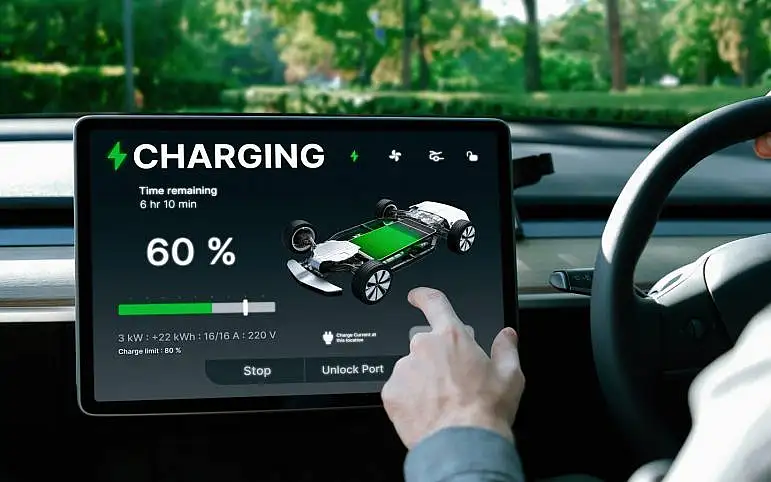
Battery State of Health is the percentage of original capacity the pack still retains; if a new 60 kWh pack now shows 85% health, it effectively offers about 51 kWh of usable capacity.
The lower the SOH, the shorter the real‑world range, the more often you must charge, and the higher the risk of cell issues over the medium term.
1.2 How does an EV battery degrade over time?
Charge/discharge cycles, high ambient temperatures, intensive use of DC fast charging, and long‑distance high‑speed driving all accelerate capacity loss.
Many packs are engineered to withstand roughly 8–10 years of normal use with acceptable SOH, but “abusive” patterns can compress this window significantly.
2. What to check on the battery before buying a used EV in Dubai
2.1 Get an official battery health report
Always request an official battery‑health report from the dealer or a trustworthy independent EV specialist, showing:
Remaining capacity percentage (e.g. 88%, 80%).
Approximate cycle count, if available.
Any fault codes stored in the Battery Management System (BMS).
Do not rely on the seller’s word or on a subjective impression of range; hard numbers are your reference.
2.2 Do a realistic range test
Don’t just look at the indicated range; test it:
Charge the car to a known level (e.g. 90%).
Drive at least 50–80 km on routes that match your typical use (city, highway).
Compare the battery percentage drop to the distance driven to estimate real‑world range.
If you see the percentage dropping dramatically or a huge gap between advertised and actual range, treat that as a serious warning sign.
2.3 Review charging history and usage patterns
Try to find out:
Did the owner mainly use home AC charging, or rely heavily on DC fast charging at public stations?
Was the car used daily for long distances in high heat?
Was it often stored for long periods at 100% or below 10% charge?
Balanced use (regular home charging, avoiding sitting at 100% for days) is generally kinder to battery health.
3. Warranty – your first line of defence against battery surprises
3.1 Check how much warranty is left
Many brands offer 7–8 years or a specific mileage (e.g. 160,000 km) of battery warranty, often with a promise to repair or replace if SOH drops below a defined threshold (such as 70%).
Before you buy, confirm:
First registration date (when the warranty clock started).
Current mileage.
Exact warranty terms (do they cover capacity loss only, or sudden failures as well?).
3.2 Confirm transferability to the new owner
Ask the dealer/service centre if the battery warranty automatically transfers to you or if you must complete certain procedures (fees, registering under your name).
Keep copies of all documentation (original invoice, service history, warranty booklet) to avoid problems if a claim is needed later.
4. Other critical checks on a used EV
4.1 Battery cooling system
In a climate like Dubai’s, battery thermal management is crucial for longevity.
Ask a specialist to verify:
No coolant leaks in liquid‑cooled systems.
Fans/pumps are working correctly.
No warning messages related to battery temperature.
4.2 Charging hardware (port and onboard charger)
Inspect the charge port for bent pins, corrosion or burn marks, especially if the car has lived on public chargers.
Confirm the car charges properly on:
AC home or wallbox charging.
DC fast charging (if possible to test).
4.3 Software updates and recalls
Many EV makers release software updates to improve efficiency, thermal management, or slightly extend range.
Ask if the car has received the latest updates and whether any battery or charging‑related recalls have been carried out.
5. Dubai‑specific factors to watch
5.1 Imported cars vs GCC‑spec
Some used EVs are imported from Europe, North America or China and priced very aggressively.
Before being tempted by the sticker:
Check that their charging standards are compatible with UAE infrastructure (plug type, DC fast‑charging protocol).
Confirm whether the original battery warranty is honoured locally or limited to the original market.
5.2 Long‑term sun and heat exposure
A car that has lived most of its life parked in open sun, with no shaded or indoor parking, may show accelerated wear in its battery and interior.
Use the cabin’s condition (cracked plastics, heavily faded trim) as a proxy for how much UV and heat exposure it has seen, and check that the A/C system is strong – it’s crucial both for comfort and, in some designs, for battery temperature control.
6. How to protect yourself from costly battery issues after buying
6.1 Follow healthy charging habits
Avoid charging to 100% every day if you don’t need full range; 80–90% is usually enough for daily use.
Don’t leave the car sitting for long periods at very low charge; try to keep it between roughly 20–80% when practical.
6.2 Use fast charging sensibly
Reserve DC fast charging for trips and genuine urgency rather than daily routine.
Make a home AC charger your primary option; it is generally gentler on the battery over years of use.
6.3 Monitor battery health regularly
Repeat a range test or request a battery‑health check every year or so to catch abnormal degradation early.
If you see a sharp drop in range within a short time, consult the dealer immediately while your warranty is still active.
7. When can a used EV with a “tired” battery still be a good deal?
If you find a used EV with, say, 75–80% SOH but at a very attractive price, ask:
Does the remaining range still cover your daily needs (for example 180–200 km instead of 350 km when new)?
Is there any battery warranty left, or can you negotiate a further discount to offset the risk or future partial replacement?
In some cases, a high‑mileage EV with lower battery health can still be a smart buy if your expectations are realistic and the price gap versus a “fresh” car is big enough.
A smart deal starts with the battery, not the touchscreen
Buying a used electric car in Dubai doesn’t have to be a gamble; it can be a very smart move if you treat the battery as both a technical and financial priority in your decision.
Between the health report, remaining warranty, previous usage patterns and charging behaviour, you can form a clear picture that helps you distinguish between an EV ready to serve you for years and one hiding a very expensive battery bill behind an attractive price tag.