
- Early Days: 2000-2010
- Quality Improvement: 2010-2018
- The Turning Point: 2019-2022
- Acceleration: 2023-2024
- Market Leadership: 2025-2026
- Key Milestones Timeline
Early Days: 2000-2010
The first Chinese cars arrived in the Middle East in the early 2000s, but they were not well received. Early models from brands like Chery and Great Wall Motors suffered from poor build quality, unreliable engines, and rudimentary safety features. Sales were limited to budget-conscious buyers who prioritized low price over quality. By 2010, Chinese brands held less than 2% of the GCC automotive market. Most dealers were hesitant to take on Chinese brands due to quality concerns and limited parts availability.
Quality Improvement: 2010-2018
Between 2010 and 2018, Chinese automakers invested heavily in quality improvement. Geely acquired Volvo in 2010, gaining access to world-class safety and engineering knowledge. BYD began developing its Blade Battery technology. Chery established assembly facilities in Iran and Egypt, building regional expertise. The first generation of genuinely competitive Chinese cars arrived around 2015, with the Geely Emgrand and Chery Tiggo series earning positive reviews from Middle East buyers. By 2018, Chinese brands had grown to approximately 5% of GCC new car sales.
The Turning Point: 2019-2022
The 2019-2022 period marked a dramatic transformation. BYD launched the Blade Battery and its e-Platform 3.0, revolutionizing EV safety and range. Geely's models, designed by former Volvo designers, matched European quality at Chinese prices. The Haval H6 became a best-seller in Saudi Arabia. Chinese EVs began appearing in significant numbers, particularly in UAE where government EV incentives attracted new brands. The COVID-19 pandemic disrupted global supply chains, but Chinese manufacturers recovered faster than competitors, gaining market share. By 2022, Chinese brands reached 8% of GCC car sales.
Acceleration: 2023-2024
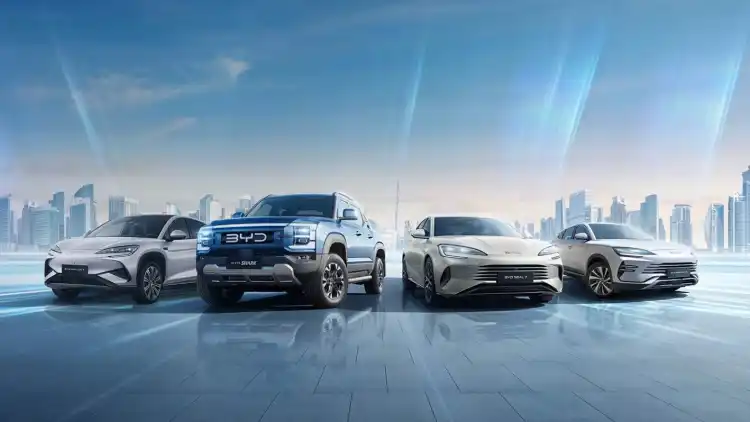
These years saw explosive growth. BYD entered the UAE market through Al-Futtaim, quickly becoming the best-selling EV brand. Nio, Zeekr, Hongqi, and Denza launched in the region. Chinese brands introduced aggressive warranty packages (5 to 7 years vs. 3 to 5 years for competitors). The Jetour brand, launched by Chery, rapidly gained popularity with its rugged SUV designs. Saudi Arabia's Vision 2030 and UAE's EV strategy created favorable conditions for Chinese brands. Market share jumped to 12% by the end of 2024.
Market Leadership: 2025-2026
By 2026, Chinese brands command over 15% of GCC new car sales. BYD is the best-selling EV brand in UAE and Saudi Arabia. Jetour's G700 and T2 models have created a new SUV segment. Hongqi competes directly with BMW and Mercedes in the luxury segment. Chinese brands now offer the longest warranties, most standard features, and best value in every segment. The quality perception has shifted from 'cheap Chinese' to 'smart Chinese.' Local assembly facilities in Saudi Arabia and UAE are expanding, further strengthening the Chinese automotive presence in the region.
Key Milestones Timeline
- 2005: Chery becomes the first Chinese brand to officially enter the Saudi market
- 2010: Geely acquires Volvo, marking the beginning of Chinese automotive globalization
- 2015: BYD launches the first-generation EV platform
- 2019: Haval H6 becomes first Chinese SUV to sell over 10,000 units annually in Saudi Arabia
- 2021: BYD launches Blade Battery, setting new safety standards
- 2023: BYD enters UAE through Al-Futtaim partnership
- 2024: Nio opens Nio House in Dubai; Jetour launches G700
- 2025: Chinese brands exceed 15% GCC market share
- 2026: Multiple Chinese brands establish local assembly in UAE and Saudi Arabia